Understanding Glaucoma and Retinal Detachment: Causes, Symptoms, and Treatments
This article provides an overview of glaucoma, a serious eye condition characterized by optic nerve damage due to increased intraocular pressure, making it the second most common cause of blindness in the U.S. Learn about the four major types—open-angle, angle-closure, congenital, and secondary glaucoma. Additionally, we discuss retinal detachment, a medical emergency that can cause blurred vision and light flashes, necessitating prompt treatment. Explore symptoms, diagnostic tests, and surgical options for these conditions.

Understanding Glaucoma and Retinal Detachment: Causes, Symptoms, and Treatments
E N D
Presentation Transcript
Eye Conditions Linsey Niles
Glaucoma • Damage of the optic nerve • Visual information from the eye to the brain • Usually due to Intraocular pressure (increased pressure in eye) • 2nd most common cause of blindness in US • “Slowly steals sight” • 4 Major types • Open-angle (chronic) • Angle-closure (acute) • Congenital • Secondary
Signs, Symptoms, & Treatment • Open-angle (chronic) glaucoma • Angle-closure (acute) glaucoma • Congenital glaucoma • Secondary glaucoma
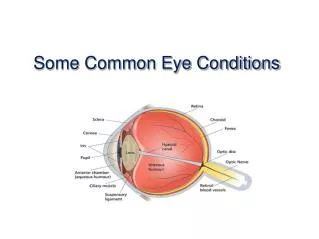
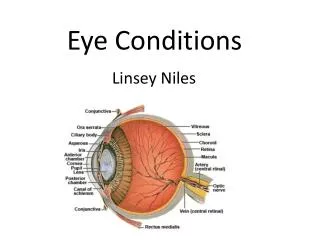
Retinal Detachment • Retina- clear tissue in back of eye • Light sensitive, helps to see images lens and cornea focus • Retina separates from supporting tissue layers • Bleeding may cause clouding of the eye • Medical emergency
Detached Retina (Cont) • Symptoms • Blurred vision • Floaters in the eye • Bright flashes of light • Signs- Test check retina and pupil response and ability to see colors properly • Treatment • Surgery • http://www.youtube.com/watch?v=A6e_LMa4pH8&feature=related
References • http://www.ncbi.nlm.nih.gov/pubmedhealth/PMH0003456/ • http://www.ncbi.nlm.nih.gov/pubmedhealth/PMH0002587/