Overview of Managerial Accounting: Lean Production and Theory of Constraints Explained
This chapter provides a comprehensive overview of managerial accounting focusing on the principles of lean production and the theory of constraints. It differentiates between financial and managerial accounting, emphasizing the importance of timely and relevant information while adhering to GAAP/IFRS standards. The discussion covers inventory management—the flow from raw materials (RM) to work in process (WIP) to finished goods (FG)—and introduces lean concepts that aim to minimize costs, reduce defects, and enhance customer response. It also explores Just-in-Time (JIT) production and the significance of managing bottlenecks in manufacturing processes.

Overview of Managerial Accounting: Lean Production and Theory of Constraints Explained
E N D
Presentation Transcript
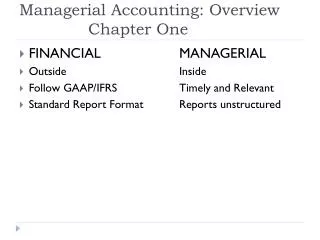
Managerial Accounting: Overview Chapter One • FINANCIAL MANAGERIAL • Outside Inside • Follow GAAP/IFRS Timely and Relevant • Standard Report Format Reports unstructured
TRADITIONALLY • “Idleness Waste Money” or • if manpower and machine are not running you are losing money
Push through production---old • PUSH through Production –old way • Three inventories: Raw Materials (RM), Work in Process(WIP), Finished Goods (FG) • RM | WIP FG • Company Queque Results in Large • Inventory waiting to be sold
Lean Production • Lean means Less Costs • Advantages: • Lower Inventory required • Fewer Defects • Less Wasted Effort • Quicker Customer Response
Lean production con’t • Summaries all theories into 1 • Value Added • Flow Chart of Activities • Manufacturing Cell • Just in Time (JIT) • Theory of Constraints
Value Added • Activities that add value per customer • Chip Box vs Dove Box
Flow Chart of Activities • Actions required to make product • Smores • Burn Place between Add SQUEEZE • MarshmellowGraham Cracker chocolate
Add the 3 M’s (Manpower, Machines, Materials) • Smores • Burn Place between Add SQUEEZE • MarshmellowGraham Cracker chocolate • Cook CookCookCook • Burner/Fork Fork Clipper Press • Marshmellow 2 Graham Crk Choc Sq
Traditional Production • Several large Machines with only one job each • Mixing Machine • Cutting Machine • Wrapping Machine
Manufacturing Work Cell • One Machine performing several jobs • Several Multi-job Machines • Each Machine Mixes-Cuts-Wraps
Just In Time (JIT) • Pull Through Production--- Customer initiates • RM WIP FG (Customer order) • Shipped immediately to customer • No queing of inventory
Theory of Constraints • Control of Bottlenecks • Increase capacity to remove bottleneck where process has smallest capacity • Freeway system --- Norwalk on Interstate 5 • Throughput time--- Cycle time to manufacture a product