
Effect of Prosthetic Gel Liner Thickness on Gait Biomechanics and Pressure Distribution
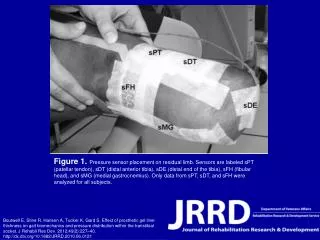
This study investigates the impact of varying gel liner thickness on gait biomechanics and pressure distribution within transtibial prosthetic sockets. Pressure sensors are strategically placed on the residual limb at key points: patellar tendon (sPT), distal anterior tibia (sDT), and fibular head (sFH). The study analyzes data from these sensors to understand how liner thickness influences comfort and function during ambulation, providing valuable insights for prosthetic design and user experience.

Effect of Prosthetic Gel Liner Thickness on Gait Biomechanics and Pressure Distribution
E N D
Presentation Transcript
Figure 1. Pressure sensor placement on residual limb. Sensors are labeled sPT (patellar tendon), sDT (distal anterior tibia), sDE (distal end of the tibia), sFH (fibular head), and sMG (medial gastrocnemius). Only data from sPT, sDT, and sFH were analyzed for all subjects. Boutwell E, Stine R, Hansen A, Tucker K, Gard S. Effect of prosthetic gel liner thickness on gait biomechanics and pressure distribution within the transtibial socket. J Rehabil Res Dev. 2012;49(2):227–40.http://dx.doi.org/10.1682/JRRD.2010.06.0121