
Understanding Earthquake Uncertainties: Implications for Hazard Assessment and Modeling

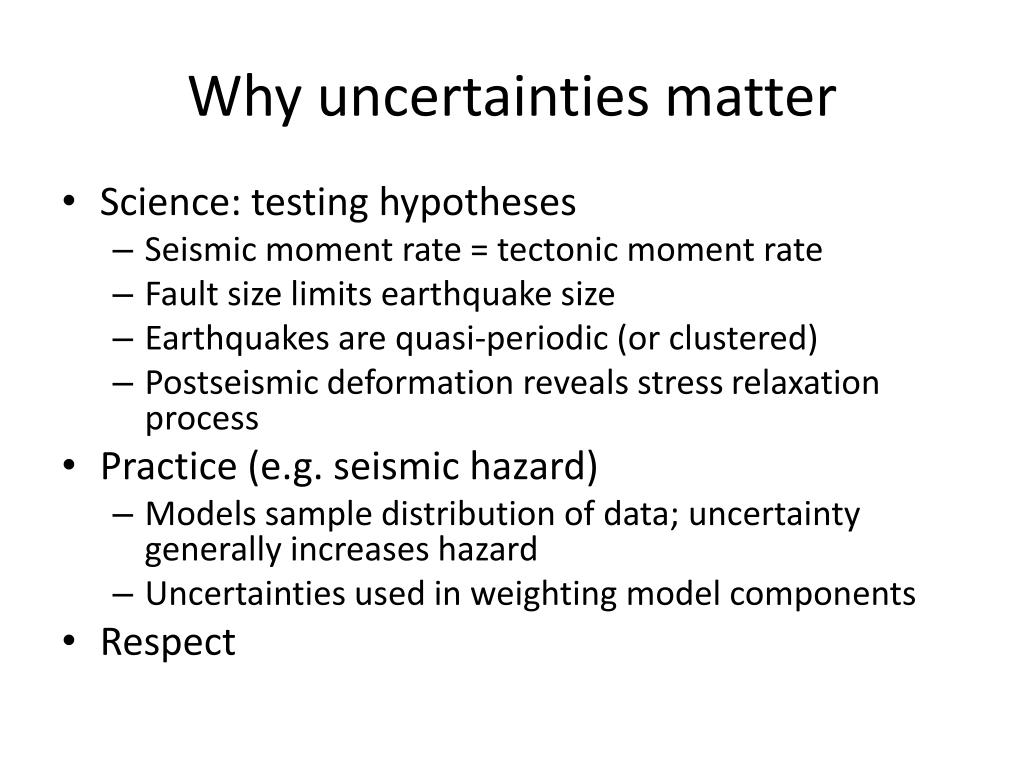
This exploration focuses on the uncertainties in earthquake science and their critical role in testing hypotheses and assessing seismic hazards. It discusses the relationship between seismic moment rate and tectonic moment rate, the limitations of fault size on earthquake magnitude, and the quasi-periodic nature of seismic events. Insights into postseismic deformation and stress relaxation processes reveal how variabilities in slip rate affect hazard modeling. The Gutenberg-Richter distribution and the Poisson process are highlighted, underscoring the significance of random occurrences in earthquake behavior over extended geological time scales.
Télécharger la présentation 
Politique de téléchargement : le contenu du site vous est fourni TEL QUEL pour votre information et votre usage personnel ; il ne peut être vendu, concédé sous licence ni partagé sur d’autres sites sans l’accord de son auteur.Le contenu vous est fourni TEL QUEL, pour votre information et votre usage personnel uniquement. Téléchargez la présentation en cliquant sur ce lien. Lors du téléchargement, si vous ne parvenez pas à télécharger une présentation, l’éditeur a peut-être supprimé le fichier de son serveur.Pendant le téléchargement, si vous ne parvenez pas à obtenir une présentation, le fichier a peut-être été supprimé par l’éditeur.
F I N