Download

1 / 19
190 likes | 293 Vues
Learn about using UPCs to study parton distributions, probe new matter phases like colored glass condensates, and understand initial states for collisions. These collisions offer higher photon energies and lower x values than fixed target experiments, reducing systematics compared to pA collisions.

E N D
Measuring Parton Densities withUltra-Peripheral Collisions in ALICE Spencer Klein, LBNL Photonuclear Interactions Measuring Structure Functions Vector Mesons Open Charm/Bottom Other Channels Experimental Feasibility in ALICE
A word from your sponsor:Why use UPCs to study parton distributions? • Several reactions are directly sensitive to gluon distributions • Directly probe ‘new phases of matter’ like colored glass condensates. • Understand initial state for central collisions • ~ 10X photon energies than even HERA • Much lower x than fixed target experiments • Smaller (or at least different) systematics than pA collisions S. Klein,LBNL
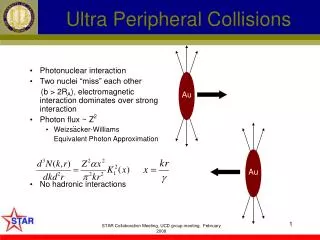
Au g qq Au X Photonuclear Interations • One nucleus emits a photon • Weizsacker-Williams flux • The photon fluctuates to a qq pair • The pair interacts with the other nucleus • If b>2R --> No accompanying hadronic interactions • Possible Reactions • Elastic qq Scattering --> Vector Meson Production • r, f, w, J/y, y’, U(1s), U(2S),… • For heavy Quark mesons, production is sensitive to parton densities • If qq = cc or bb --> Heavy quark photoproduction • Diject production S. Klein,LBNL
Au qq g V Au Vector Meson Production • Quark-nucleus elastic scattering • Coherent enhancement to cross section • Light vector mesons (r,w,f,r*…) • Soft (optical model) Pomeron • Heavy vector mesons (J/y, y’, U…) • Probe short distance scales • Scattering may be described via 2-gluon exchange • Sensitive to gluon distribution at • x = MV/2gmp exp(± y) • Q2 ~ MV2 S. Klein,LBNL
The effect of shadowing • s(VM) ~ |g(x,Q2)|2 • Shadowing reduces cross section • Factor of 5 for one standard shadowing model • Rapidity maps into x • y = ln(2xgmp/mV) • x= mV/2gmp exp(y) • A colored glass condensate could have a larger effect No shadowing ds/dy, mb FGS shadowing y Frankfurt, Strikman & Zhalov, 2001 S. Klein,LBNL
Au Au qq qq V V g g Au Au The 2-fold ambiguity Or… • Which nucleus emitted the photon? • X or k ~ mV/2gmp exp(y) • Photon fluxes, cross sections for two different photon energies (directions) are different • 2 Solutions • Stick to mid-rapidity • For J/y at y=0, x= 6*10-4 • Compare two reactions • Pb + Pb --> Pb + Pb + J/Y • Pb + Pb --> Pb* + Pb* + J/Y • Different reactions have different photon flux ratios • System of 2 linear equations S. Klein,LBNL
Rates (w/o shadowing) • J/y --> 3.2 Hz --> 3M/ 106 s • ~ 300,000 Y’ and 17,000 U(1S) • 36,000 J/y --> e+e- with |y|<1 (ALICE central) • ~360 Y’ and ~100 Y(1s) • 27,000 J/y --> e+e- with 2.5 <y< 4 (ALICE m spect.) • ~ 270 y’ and ~75 U(1s) • Rates are higher with lighter ions (higher LAA) S. Klein,LBNL
AA vs. pA vs. pp • Exclusive J/y production can be studied in AA, p/dA and pp collisions • Rates are high with all species • With it’s distinctive signature, signal to noise ratio should be high for all species • In p/dA collisions the photon usually comes from the nucleus, and strikes the proton/deuteron. • Avoids two-fold ambiguity for proton targets • Measure parton distributions in protons and nuclei • Compare reactions --> low-systematics measurement of shadowing S. Klein,LBNL
Reconstruction • Exactly 2 tracks in event • pT < 150 MeV/c • leptons are nearly back-to-back • PID as leptons • 1 e in PHOS + 1 e in EMCAL? • 2 muons in spectrometer PHENIX, QM2004 S. Klein,LBNL
Triggering • For UPCs, Level 0 cannot use multiplicity trigger • Need L0 from muon spectrometer (present?) or calorimetry or TRD • L1 from and/or muon spectrometer & calorimetery/TRD • L2 due to dileptons (+ low multiplicity?) • N.b. Many ‘central collision’ analyses will face the same problem with pp collisions S. Klein,LBNL
Open Charm/Bottom Au qq g V Au Nuclear debris • Occurs via gluon exchange • Well described in QCD (& tested @ HERA) • Sensitive to gluon distribution • x and Q2 depend on final state configuration (M(QQ)…) • Wider range of Q2 than vector meson production • High rates • s(charm) ~ 1.8 barns ~ 25% of shadronic • S(bottom) ~ 700 mb ~ 1/10,000 of shadronic • (without shadowing) • One nucleus breaks up S. Klein,LBNL
Single Quark pT Single Quark y1 Pair Mass (GeV) Charm kinematic distributions Solid – Total Dashed – Direct/2 Dot-Dashed – Resolved Photon Contribution 2 sets of curves are with EKS98 (small) and w/o shadowing SK, Joakim Nystrand & Ramona Vogt, 2002 S. Klein,LBNL
Charm Reconstruction • cc reconstruction • Well-understood techniques • Direct Reconstruction of charm • Should be feasible in ALICE • Probably can’t reconstruct both c and cbar • Semi-leptonic decay • Should be able to detect leptons from dual semi-leptonic decay S. Klein,LBNL
Separating Photoproduction and Hadroproduction • Photoproduction of charm is very favorable • P(g --> cc) ~ 4/10 • Cross Sections are large • s(charm photoproduction) ~ 1.8 barns • For lead at the LHC • No shadowing • s(charm hadroproduction) ~ 240 barns SK, Joakim Nystrand & Ramona Vogt, 2002 S. Klein,LBNL
Rejecting Hadroproduction • Single nucleon-single hadronic interactions • Eliminate more central reactions with multiplicity cut • s1n1n ~ 700 mb • s1n1n, with charm ~ 5.5 mb • sb>2R with charm ~ 1100 mb • One nucleus remains intact • Assume <10% chance • Particle-free rapidity gap around photon emitter • P~ exp(-Dy dN/dy) • dNch/dy ~ 4.4 at midrapidity for pp the LHC • 40% lower at large |y| • For Dy= 2 units, P ~ 0.005 • sremaining, with charm ~ 3 mb SK, Joakim Nystrand & Ramona Vogt, 2002 S. Klein,LBNL
Triggering • Direct Charm reconstruction • Trigger is tough • Semileptonic Decays • Use leptons, as with vector mesons • May get some usage out of multiplicity detectors S. Klein,LBNL
Other channels • Dijets • Large rates • s(ET> 20 GeV) ~ 1/minute • Separating photoproduction and hadroproduction seems difficult • Photon + jet (Compton scattering) • s (1% of dijet rate) Ramona Vogt, 2004 S. Klein,LBNL
Other UPC studies in ALICE • Photoproduction of W+W- • Study gWW vertex • gg --> Higgs? • Rate is low, but this is important in establishing the nature of the Higgs • Vector Meson Spectroscopy • If trigger problem can be solved • e+e- pair production • A test of strong field QED • Enormous rates (13,000 barns in SPD1) • A trigger is probably not needed S. Klein,LBNL
Conclusions • UPC photoproduction can be used to measure the parton distributions in ions and protons, and test colored glass condensate models of nature. • Both vector meson and open charm can be studied with ALICE. • The analyses seem rather straightforward. • Attention to the trigger will be required to collect the data required for these analyses. • Many other UPC studies are possible S. Klein,LBNL