Download
1 / 1
10 likes | 136 Vues
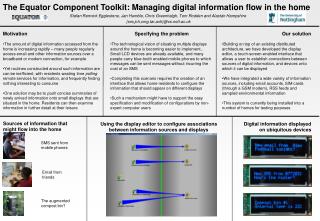
The need for effective management of digital information in homes is growing as more residents access emails and other online sources. Conventional routines often lead to inefficiencies, with users spending time checking remote services for updates. Our solution, utilizing The Equator Component Toolkit, introduces a system of small displays that relay concise summaries of new information directly to users. The display editor, a user-friendly touch-screen interface, allows residents to configure which information appears on various screens, integrating sources such as email, RSS feeds, and environmental data for an optimized digital experience.

E N D
The Equator Component Toolkit: Managing digital information flow in the home Stefan Rennick Egglestone, Jan Humble, Chris Greenhalgh, Tom Rodden and Alastair Hampshire {sre,jch,cmg,tar,axh}@cs.nott.ac.uk • Motivation • The amount of digital information accessed from the home is increasing rapidly – many people regularly access email and other information sources over a broadband or modem connection, for example • Yet routines constructed around such information are can be inefficient, with residents wasting time polling remote services for information, and frequently finding nothing interesting to consume • One solution may be to push concisesummaries of newly arrived information onto small displays that are situated in the home. Residents can then examine information in further detail at their leisure • Specifying the problem • The technological vision of situating multiple displays around the home is becoming easier to implement.. Small LCD devices are already available, and many people carry blue-tooth enabled mobile phones to which messages can be sent messages without incurring the cost of an SMS • Completing this scenario requires the creation of an interface that allows home residents to configure the information that should appear on different displays • Such a mechanism might have to support the easy specification and modification of configurations by non-expert computer users • Our solution • Building on top of an existing distributed architecture, we have developed the display editor, a touch-screen-enabled interface that allows a user to establish connections between sources of digital information, and devices onto which it can be displayed • We have integrated a wide variety of information sources, including email accounts, SIM cards (through a GSM modem), RSS feeds and sampled environmental information • This system is currently being installed into a number of homes for testing purposes Sources of information that might flow into the home Using the display editor to configure associations between information sources and displays Digital information displayed on ubiquitous devices SMS sent from mobile phones Email from friends The augmented compost bin?