
Forward Chaining Systems
E N D
Presentation Transcript
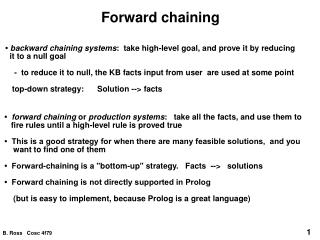
Forward Chaining Systems • also known as Production Systems • commonly used for Expert Systems • knowledge based must consist of facts and rules (Horn clauses, extended with retraction) • will describe the Rete Algorithm • representation of concepts as network or graph
Rete Algorithm • create a network where nodes represent ground literals (predicates with concrete arguments) • rules link antecedents to consequent • rules can create new nodes • start by activating nodes corresponding to facts • each iteration, determine which rules can fire • pick one and modify network • run until quiescence • produces all the consequences of the facts
Conflict Resolution • What happens when 2 rules can fire that have opposite effects? e.g assert(P) and retract(P)? • assign numeric priorities to rules – highest wins • can retract antecedents of other rules
(defrule library-rule-1 (book (name ?X) (status late) (borrower ?Y)) (borrower (name ?Y) (address ?Z)) => (send-late-notice ?X ?Y ?Z)) Examples in JESS (deffacts trouble_shooting (car_problem (name ignition_key) (status on)) (car_problem (name engine) (status wont_start)) (car_problem (name headlights) (status work)) ) (defrule rule1 (car_problem (name ignition_key) (status on)) (car_problem (name engine) (status wont_start) (car_problem (name battery) (status OK)) => assert (car_problem (name starter) (status faulty))) ) (defrule rule2 (car_problem (name headlights) (status work)) => assert (car_problem (name battery) (status OK)) ) ignition_key: on starter: faulty engine: wont_start battery: OK headlights: work
Implementations • ACT, SOAR – cognitive models, simulate retrieval from long-term/short-term memory, activation by association, activation decay • CLIPS – C-based developed at NASA • JESS – Java-based, popular • Subsumption Architecture (Rodney Brooks) • intelligent behavior in robots can be produced in a decentralized way by a lot simple rules interacting • divide behaviors into lower-level basic survival behaviors that have higher priority, and higher-level goal-directed behaviors • example: 6-legged robot ants learning to walk
Description Logics • Theorem: entailment FOL is undecidable • theorem provers like resolution might take a long time to find a proof • Goal: knowledge representation system in which inference is more efficient than FOL • solution: restrict expressiveness (e.g. eliminate disjunction and negation) • remember: proofs with Horn-clauses are linear-time • will describe several DL systems • see Ch. 1 of Handbook of Description Logics for overview, link posted on web • focus on defining taxonomy of concepts • currently popular for web applications (“Semantic Web”)
Concept Description Syntax • see fig 12.7 (p. 456) in book • T-box – terminological, concept definitions Concept ::= Thing | ConceptName | AND(Concept...) | All(RoleName,Concept) | AtLeast(Int,RoleName) | AtMost(Int,RoleName) | Fills(RoleName,Individual) | OneOf(Individual...) • Bachelor = AND(Adult,Male,Unmarried) • MotorCycle = AND(vehicle,AtMost(2,wheels)) • HonorStudent ALL(Fills(Grade,A),Fills(ClassTaken,Class)) • A-box – assertional, describe individuals • Male(bob), Fills(sister(bob),sue)
Family of DL languages • described in Ch. 2 of Handbook of DL AL family a person who has at most one child, or 3 or more children including a daughter ALCN: full existential quantification full negation full number restriction
Inference • subsumption: is CD? • reduce to satisfiability • C∩D? • is the “bottom” or NULL concept, nothing is in this set • classification: find all subset relationships in hierarchy • tableau algorithms • make model by expanding and re-writing concept definitions, or detect failure • PSPACE-complete for ALCN
Semantic Web • OWL - Web Ontology • extend data in XML with inference rules (written in RDF) • SHOIQN semantics • for example, if web page A is annotated with <student> <name>Joe Smith</name> <advisor>Dr. Hank Walker</advisor> <institution>TAMU</institution> </student> • then should be able to infer that Dr. Walker is a faculty member at TAMU
Implementations • old: CLASSIC, KL-ONE, LOOM • modern: Protege • Applications • medical records • SNOMED ontology – describes terms for symptoms, diseases, procedures, anatomy, etc. • Dublin Core • for information retrieval/media archiving • describes books, journals, thesis, authors, publishers, ISBN, revisions, affiliations, conferences...