
Nervous System: Master Controller of Body Functions
E N D
Presentation Transcript
Nervous System • Master controller and communicating system in the body • Every thought, action and emotion reflects its activity. • It signals the body through electrical impulses that communicate with the body cells. • Its signaling and responding abilities are highly specific and rapid.
Functions of the Nervous System • Sensory input – gathering information • To monitor changes occurring inside and outside the body • Changes = are called stimuli • Integration • N.S. is able to integrate this information • Process and interpret sensory input and decide if action is needed
Functions of the Nervous System • Motor output • A response to the integrated stimuli • The response activates muscles or glands The NS does not work alone in maintaining homeostasis. • it enlists the endocrine system for regulating and maintain body functions.
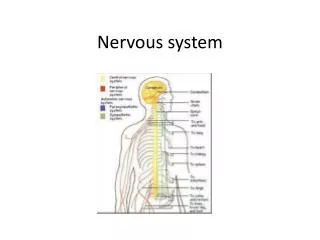
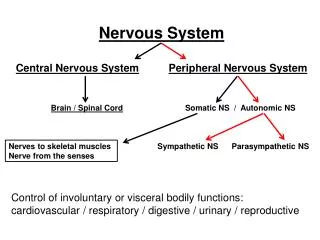
Structural Classification of the Nervous System • Central nervous system (CNS) • Brain • Spinal cord • Peripheral nervous system (PNS) • Nerve outside the brain and spinal cord
Functional Classification of the Peripheral Nervous System • Sensory (afferent) division - carrying toward a center • Nerve fibers that carry information to the central nervous system • Somatic sensory (skin, skeletal muscle) • Visceral sensory (visceral organs)
Functional Classification of the PNS • Motor (efferent) division • Nerve fibers that carry impulses away from the central nervous system • Activate (effect) muscles or glands to bring about a response. Figure 7.1
Functional Classification of the PNS • Motor (efferent) = 2 division • Somatic nervous system = voluntary (skeletal muscles) • Autonomic nervous system = involuntary (smooth and cardiac muscles, glands)
Nervous Tissue • Comprise of 2 types of cells • Neuroglia = supporting cells • The insulators, adhesive, protectors and nourishers • Neurons = nerve cells that transmit impulses
Nervous Tissue: Support Cells (Neuroglia) • Astrocytes • Abundant, star-shaped cells • Brace neurons • Form barrier between capillaries and neurons • Control the chemical environment of the brain
Nervous Tissue: Support Cells • Microglia • Spider-like phagocytes • Dispose of debris • Ependymal cells • Line cavities of the brain and spinal cord • Circulate cerebrospinal fluid Figure 7.3b–c
Nervous Tissue: Support Cells • Oligodendrocytes • Produce myelin sheath around nerve fibers in the central nervous system Figure 7.3d
Nervous Tissue: Support Cells • Satellite cells • Protect neuron cell bodies • Schwann cells • Form myelin sheath in the peripheral nervous system Figure 7.3e
Nervous Tissue: Neurons • Neurons = nerve cells • Cells specialized to transmit messages • Major regions of neurons • Cell body – nucleus and metabolic center of the cell • Processes – fibers that extend from the cell body
Neuron Anatomy • Cell body • Nissl substance – specialized rough endoplasmic reticulum • Neurofibrils – intermediate cytoskeleton that maintains cell shape
Neuron Anatomy • Cell body • Nucleus • Large nucleolus Figure 7.4a–b
Neuron Anatomy • Extensions outside the cell body • Dendrites – conduct impulses toward the cell body • Axons – conduct impulses away from the cell body Figure 7.4a
Axons and Nerve Impulses • Axons end in axonal terminals • Axonal terminals contain vesicles with neurotransmitters • Axonal terminals are separated from the next neuron by a gap • Synaptic cleft – gap between adjacent neurons • Synapse – junction between nerves
Nerve Fiber Coverings • Schwann cells – produce myelin sheaths in jelly-roll like fashion • Nodes of Ranvier – gaps in myelin sheath along the axon
Location of Neuron Cell Body • Most are found in the central nervous system • Gray matter – cell bodies and unmylenated fibers • Nuclei – clusters of cell bodies within the white matter of the central nervous system • Ganglia – collections of cell bodies outside the central nervous system
Functional Classification of Neurons • Sensory (afferent) neurons • Carry impulses from the sensory receptors • Cutaneous sense organs • Proprioceptors – detect stretch or tension • Motor (efferent) neurons • Carry impulses from the central nervous system
Functional Classification of Neurons • Interneurons (association neurons) • Found in neural pathways in the central nervous system • Connect sensory and motor neurons
Structural Classification of Neurons • Multipolar neurons – many extensions from the cell body Figure 7.8a
Structural Classification of Neurons • Bipolar neurons – one axon and one dendrite Figure 7.8b
Structural Classification of Neurons • Unipolar neurons – have a short single process leaving the cell body Figure 7.8c
Functional Properties of Neurons • Irritability – ability to respond to stimuli • Conductivity – ability to transmit an impulse • The plasma membrane at rest is polarized • Fewer positive ions are inside the cell than outside the cell
Starting a Nerve Impulse • Depolarization – a stimulus depolarizes the neuron’s membrane • A deploarized membrane allows sodium (Na+) to flow inside the membrane • The exchange of ions initiates an action potential in the neuron
The Action Potential • If the action potential (nerve impulse) starts, it is propagated over the entire axon • Potassium ions rush out of the neuron after sodium ions rush in, which repolarizes the membrane • The sodium-potassium pump restores the original configuration • This action requires ATP
Nerve Impulse Propagation • The impulse continues to move toward the cell body • Impulses travel faster when fibers have a myelin sheath Figure 7.9d–f
Continuation of the Nerve Impulse between Neurons • Impulses are able to cross the synapse to another nerve • Neurotransmitter is released from a nerve’s axon terminal • The dendrite of the next neuron has receptors that are stimulated by the neurotransmitter • An action potential is started in the dendrite
How Neurons Communicate at Synapses Figure 7.10
The Reflex Arc • Reflex – rapid, predictable, and involuntary responses to stimuli • Reflex arc – direct route from a sensory neuron, to an interneuron, to an effector
Simple Reflex Arc Figure 7.11b–c
Types of Reflexes and Regulation • Autonomic reflexes • Smooth muscle regulation • Heart and blood pressure regulation • Regulation of glands • Digestive system regulation • Somatic reflexes • Activation of skeletal muscles
Central Nervous System (CNS) • CNS develops from the embryonic neural tube • The neural tube becomes the brain and spinal cord • The opening of the neural tube becomes the ventricles • Four chambers within the brain • Filled with cerebrospinal fluid
Regions of the Brain • Cerebral hemispheres • Diencephalon • Brain stem • Cerebellum Figure 7.12b
Cerebral Hemispheres (Cerebrum) • Paired (left and right) superior parts of the brain • Include more than half of the brain mass • The surface is made of ridges (gyri) and grooves (sulci) Figure 7.13a
Lobes of the Cerebrum • Fissures (deep grooves) divide the cerebrum into lobes • Surface lobes of the cerebrum • Frontal lobe • Parietal lobe • Occipital lobe • Temporal lobe
Specialized Areas of the Cerebrum • Somatic sensory area – receives impulses from the body’s sensory receptors • Primary motor area – sends impulses to skeletal muscles • Broca’s area – involved in our ability to speak
Sensory and Motor Areas of the Cerebral Cortex Figure 7.14
Specialized Areas of the Cerebrum Cerebral areas involved in special senses • Gustatory area (taste) • Visual area • Auditory area • Olfactory area Interpretation areas of the cerebrum • Speech/language region • Language comprehension region • General interpretation area
Layers of the Cerebrum • Gray matter • Outer layer • Composed mostly of neuron cell bodies • White matter • Fiber tracts inside the gray matter • Example: corpus callosum connects hemispheres • Basal nuclei – internal islands of gray matter
Diencephalon • Sits on top of the brain stem • Enclosed by the cerebral heispheres • Made of three parts • Thalamus • Hypothalamus • Epithalamus
Diencephalon Figure 7.15
Thalamus • Surrounds the third ventricle • The relay station for sensory impulses • Transfers impulses to the correct part of the cortex for localization and interpretation
Hypothalamus • Under the thalamus • Important autonomic nervous system center • Helps regulate body temperature • Controls water balance • Regulates metabolism • An important part of the limbic system (emotions) • The pituitary gland is attached to the hypothalamus
Epithalamus • Forms the roof of the third ventricle • Houses the pineal body (an endocrine gland) • Includes the choroid plexus – forms cerebrospinal fluid
Attaches to the spinal cord Parts of the brain stem Midbrain Pons Medulla oblongata Brain Stem