4.4 Modeling and Optimization
70 likes | 180 Vues
In this classic optimization problem, you have 40 feet of fencing available to enclose a rectangular garden adjacent to a barn. The goal is to maximize the enclosed area. To solve this, express the area in terms of one variable, derive the first derivative, set it to zero, and evaluate endpoints to find local maxima or minima. Additionally, explore the dimensions for a one-liter cylindrical can that minimizes material use by analyzing surface area equations. This exercise illustrates the application of mathematical modeling and optimization techniques.


4.4 Modeling and Optimization
E N D
Presentation Transcript
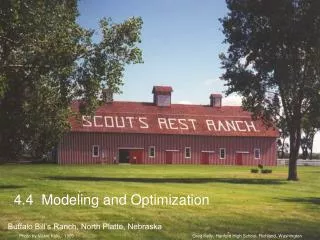
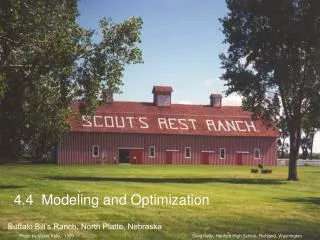
Photo by Vickie Kelly, 1999 Greg Kelly, Hanford High School, Richland, Washington 4.4 Modeling and Optimization Buffalo Bill’s Ranch, North Platte, Nebraska
There must be a local maximum here, since the endpoints are minimums. A Classic Problem You have 40 feet of fence to enclose a rectangular garden along the side of a barn. What is the maximum area that you can enclose?
A Classic Problem You have 40 feet of fence to enclose a rectangular garden along the side of a barn. What is the maximum area that you can enclose?
1 Write it in terms of one variable. 2 Find the first derivative and set it equal to zero. 3 Check the end points if necessary. To find the maximum (or minimum) value of a function:
Example 5: What dimensions for a one liter cylindrical can will use the least amount of material? Motor Oil We can minimize the material by minimizing the area. We need another equation that relates r and h: area of ends lateral area
Example 5: What dimensions for a one liter cylindrical can will use the least amount of material? area of ends lateral area
Notes: If the function that you want to optimize has more than one variable, use substitution to rewrite the function. If you are not sure that the extreme you’ve found is a maximum or a minimum, you have to check. If the end points could be the maximum or minimum, you have to check. p