Download
1 / 22
230 likes | 343 Vues
Explore the diverse landscape of world religions in this engaging study series at the First Baptist Church of Pittsburgh. Each week, we delve into a different tradition, starting with definitions of cults and moving through Hinduism, Buddhism, Judaism, Christianity, Islam, and new religions. Participants will gain insights into the historical contexts, key beliefs, and practices that shape these faiths. Join us for a comprehensive overview that considers the relevance of these religions today, especially in the context of local communities in Pittsburgh.

E N D
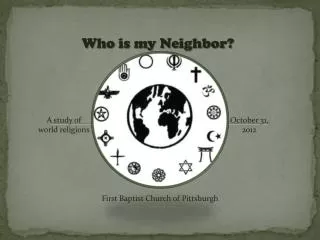
Who is my Neighbor? A study of world religions October 31, 2012 First Baptist Church of Pittsburgh
Week 2: What is a Cult? OCT. 10 - Megan • Scholarly vs. Popular Definition • Common Traits • Examples • Week 3: Hinduism Brief History OCT. 17 – Megan (Kittie will contribute TM materials) • Vedas • Shaivas, Vaishnavas, Goddess followers • Beliefs & Practice • Week 4: Buddhism OCT 24 – Megan • Brief History • Theravada, Mahayana, Vajrayana • 4 Truths, Eight-fold Path • Mahayana Sects (Zen/Chan, Pure Land, etc.) • Beliefs & Practice • Week 5: "Minor" Religions OCT. 31 - Megan • Zoroastrianism • Sikhism • Jainism • Taoism • Shinto
Week 6: Judaism NOV. 7 – Kittie • Brief history • Ancient vs. Modern • Orthodox vs. Reformed • Beliefs and Practices • Week 7: Christianity NOV. 14 - Kittie • Brief History • Protestant, Catholic, Orthodox, Other • Beliefs & Practice • NOV 21 – NO CLASS, BREAK FOR THANKSGIVING • Week 8: Islam NOV. 28 - Kittie • Brief History • Four pillars • Shiite vs. Sunni • Sufism • Week 9: New Religions (post 1800) DEC. 5 - Kittie • Mormonism • Jehovah's Witnesses • Scientology • Neo-Paganism/Wicca • Various New Asian Religions • Week 10: Overview/Summary: What Does All This Mean for Christians?
“Minor” Religions Jainism, Taoism, Confucianism, Sikhism, Zoroastrianism
Minor Religions in Pittsburgh • Hindu Jain Temple • Zoroastrian Association of Pennsylvania - Pittsburgh • Pittsburgh Sikh Gudwara – Monroeville (below)
Jainism • Began in India between the 9th and 6th centuries BCE. • Has about 6 million followers in India alone. • Mahavrata (“Great Vows”): 5 principles by which Jains live. • Ahimsa – non-violence; applies to animals as well as people, even insects and microorganisms • Satya – truthfulness; second to ahimsa. In a situation where telling the truth would lead to violence, one should remain silent. • Asteya – non-stealing; one should always give a fair wage to laborers and a fair price for products, in addition to not taking something belonging to another. • Brahmacharya – celibacy; monks and nuns are completely celibate, lay people are prohibited from being in sensual contact with anyone besides their spouse. • Aparigraha – non-possession; one should not seek after possessions, and should not possess more than one needs.
Jainism • 24 Tirthankaras – lit. ‘ford-builder’; 24 people who became ‘pure souls’ who can help others achieve liberation. Only the last two are considered to have been historical by scholars. • Karma – in Jainism, karma is conceived of as a sort of soot-like substance which clings to the soul and keeps it from rising out of samsara.
Jain Practices • Monks carry small brooms and sweep the ground ahead of them so that they do not accidentally step on any insects. • Vegetarianism – Jains are strictly vegetarian; they also do not eat root vegetables. • Fasting, prayer, offerings, and meditation • Sallekhana – when a Jain is close to death, they may willingly chose to abstain from food and drink. This is seen as a way to remove a lot of karma.
Taoism (Daoism) • Approximately 400 million adherents in China • Part philosophy, part religion • Main texts: the Daodejing and the Zhuangzi • Dates back to the Han Dynasty in China (c. 200 BCE – 200 CE) • Not a single, coherent, organized religion
Taoist Beliefs • Tao – ‘the way’; both ‘path’ and ‘doctrine’ • Te – the expression of Tao; ‘power’ or ‘virtue’ • Wu-wei – ‘nonaction’; one must be like water, in harmony with their surroundings/the universe • Ziran – ‘naturalness’; the original state of all things • Sanbao – ‘Three Treasures’; compassion, moderation, and humility • Qi – ‘life force’ • Yin and Yang – the two main components of all things; nothing can be reduced to pure yang or pure yin • Yin – cold, wet, dark, feminine • Yang – hot, dry, bright, masculine
Taoist Beliefs and Practices • Pantheon – differs between sects, but generally mirrors the traditional Chinese bureaucracy, with deities being promoted/demoted based on their actions; headed by the Jade Emperor. • Exorcisms • Alchemy – goal of prolonging one’s life • Astrology/Divination
Confucianism • Confucius (Kong Fuxi) lived from 551-479 BCE, during a period of political disunification. • Non-theistic • Six books • Classic of Poetry – prophecy • Book of Documents – history • Book of Rites – laws • Book of Music – rituals • Classic of Change – divination • Spring and Autumn Annals – chronicle of the state of Lu
Confucian Ethics • Five virtues • Ren - humaneness • Yi – righteousness/justice • Li - etiquette • Zhi – knowledge • Xin – integrity • Sizi (four virtues) • Loyalty • Filial piety • Continency • Righteousness
Confucian Ethics • Five Relationships • Ruler to Ruled • Father to Son • Husband to Wife • Elder Brother to Younger Brother • Friend to Friend • The gentleman – typically described as a scholar/literate person, is supposed to cultivate morality, filial piety, and ren • Rectification of Names – the need for things to be properly recognized as they are
Confucian Controversy • Ancestor Worship • Argument between the Pope and Jesuits as to whether Confucianism was a philosophy or a religion • Were ancestor veneration rituals worship or just to respect the dead? • Women and Confucianism • Traditionally constrained by gender roles • 'three subordinations': be subordinate to her father before marriage, to her husband after marriage, and to her son after her husband died. • Considered virtuous to die as a widow
Sikhism • 30 million Sikhs worldwide • Follow the ten gurus, first was Nanak Sahib • Born in the 15th cent., CE • Main scripture: Gurū Granth Sāhib Ji • monotheistic
Sikh Beliefs • God is not fully knowable • Can only be seen through the heart, by meditation • God is genderless, formless • Final destination is spiritual union with God • Maya – ‘unreality’ • Results in separation from God • Five evils: ego, anger, greed, attachment, lust • All are equal in God’s eyes • Women can lead in prayers
Sikh Practices • Langar – community meal • Served at the Gudwara (Sikh place of worship) to the entire community • Naming ceremony • All boys are given the last name Singh (‘lion’) and girls the last name Kaur (‘lioness’) • Guru Granth Sahib is opened randomly and the child is given a name with the first letter on the top left hand corner of the left page. • Sikhs are required to marry when they reach a certain age; divorce is prohibited
Sikh Practices • The Five K’s • kēs(uncut hair) • kaṅghā(small wooden comb) • kaṛā(circular steel or iron bracelet) • kirpān(sword/dagger) • kacchera(special undergarment) • Prohibitions: • Cutting hair • Intoxication • Adultery • Blind spirituality • Material obsession • Sacrifice of creatures • Non-family-oriented living • Worthless talk • Priestly class • Eating meat killed in a ritualistic manner • Having premarital or extramarital sexual relations
Zoroastrianism • Originated in Persia c. 6th-18thcent. BCE • Founded by the prophet Zoroaster • Monotheistic – God is called ‘Ahura Mazda’ (means ‘Lord of light and wisdom’)
Zoroastrian Beliefs • Asha – truth/order • Druj – falsehood/disorder • Agra Manyu – lit. ‘evil spirit’; the antithesis of Ahura Mazda • Saoshyant – a messiah-figure who will appear at the end of time to resurrect the dead. • The universe is egg-shaped, created to stop Agra Manyu • The dead must cross the Bride of Judgement to paradise or hell • Hell is unpleasant but not eternal; punishment fits crimes
Zoroastrian Practices • Dead are exposed in ‘towers of silence’ • After some corpses poisoned birds of prey, some communities have switched to cremation or burial. • Do not want corpses to pollute creation • Free will is embraced, predestination is not accepted • Water and fire are seen as bringing about ritual purity • Fire Temple – a Zoroastrian place of worship • Worship through fire, do not worship fire • Do not accept any form of monasticism • Men, women, and children must all keep their heads covered.