Download
1 / 11
110 likes | 221 Vues
Ubiquinone (Q) is essential for H+ shuttling, maintaining the proton motive force (pmf) to drive ATP synthesis. Through a series of reactions involving cytochrome bc1, Q is reduced to QH2, facilitating H+ transport across the membrane and ATP generation via ATPase. Microbial growth dynamics can be described using the Monod and Michaelis-Menten equations, accounting for substrate availability. In biofilms, microbial communities such as ‘thiovulum’ exhibit complex structures with specialized functions and communication via quorum sensing, enhancing resistance against antimicrobial attacks.

E N D
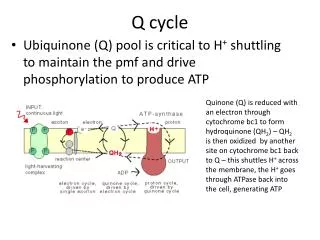
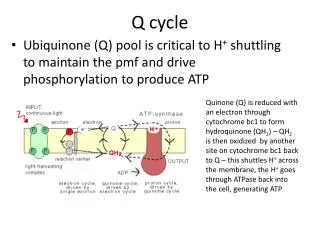
Q cycle • Ubiquinone (Q) pool is critical to H+ shuttling to maintain the pmf and drive phosphorylation to produce ATP Quinone (Q) is reduced with an electron through cytochrome bc1 to form hydroquinone (QH2) – QH2 is then oxidized by another site on cytochrome bc1 back to Q – this shuttles H+ across the membrane, the H+ goes through ATPase back into the cell, generating ATP
Growth • Monod equation – accounts for substrate availability and idea that organism can only eat so fast… (saturation of transporters) • Michaelis-Menton equation, derived from enzyme activities, also accounts for substrate availability and idea that specific number of enzymes can only work so fast…
Specific growth rate, m, (time-1) • Specific metabolic rate, V, (mmol cell-1 h-1)
0.5 m ‘thiovulum’ mats, Pozzo di Cristale, Frassassi caves
Biofilms’ genetic expression different • When in a biofilm the same organism express different proteins • Functions become specialized
Different cells communicate to coordinate behaviors/genetic expression in a biofilm • Cells can sense when there is a sufficient density of cells and the conditions to create a biofilm – quorum sensing
Capabilities of the group • Biofilms are ore resistant to attack than planktonic expressions of the same organisms (attack = antimicrobial agents, viruses, physicochemical changes)