Effective Problem-Solving Techniques: Steps and Strategies for Success
130 likes | 251 Vues
This resource provides a comprehensive overview of essential problem-solving techniques, focusing on Polya’s four-step method: understanding the problem, devising a plan, carrying out the plan, and looking back at the solution. Learn to translate real-world scenarios into algebraic equations, utilize formulas, and discuss various strategies like organizing information, recognizing patterns, and solving simpler problems. Practical examples, including negotiating contracts and managing finances, illustrate the application of these techniques in solving everyday challenges.


Effective Problem-Solving Techniques: Steps and Strategies for Success
E N D
Presentation Transcript
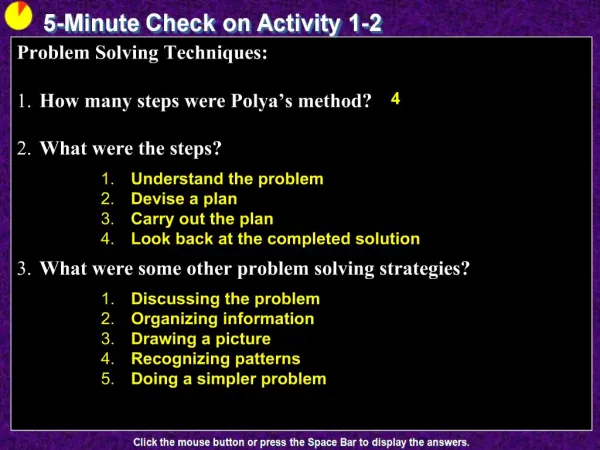
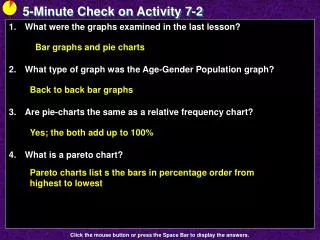
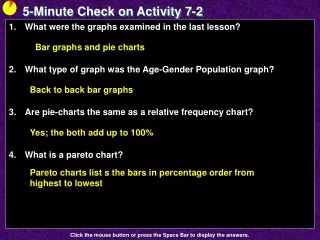
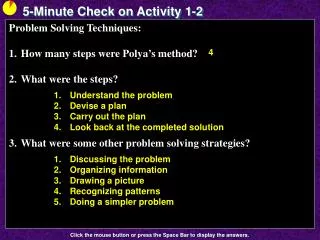
5-Minute Check on Activity 1-2 • Problem Solving Techniques: • How many steps were Polya’s method? • What were the steps? • What were some other problem solving strategies? 4 • Understand the problem • Devise a plan • Carry out the plan • Look back at the completed solution Discussing the problem Organizing information Drawing a picture Recognizing patterns Doing a simpler problem Click the mouse button or press the Space Bar to display the answers.
Activity 1 - 3 Make Me an Offer or Show me the Money!
Objectives • Use the basic steps for problem-solving • Translate verbal statements into algebraic equations • Use the basic principles of algebra to solve real-world problems • Use formulas to solve problems
Vocabulary • Formula – an equation involving letters as variables
Basic Steps in Problem Solving Solving any problem generally requires the following four steps • Understand the problem • Develop a strategy for solving the problem(Devise a plan) • Execute your strategy to solve the problem(Carry out the plan) • Check your solution for correctness (Look back at the completed solution)
Description “Night Train” Henson is negotiating a new contract with his team. He wants $800,000 for the year and an additional $6000 for every game he starts. His team offered $10,000 for every game he starts, but only $700,000 for a base salary. How many games would he need to start in order to make more with the team’s offer? His offer < Team’s offer 800,000 + 6,000S < 700,000 + 10,000S 100,000 < 4,000S 25 < S
Checking Account You need to open a checking account and decide to shop around for a bank. Acme bank has an account with a $10 monthly charge, plus 25 cents per check. Farmer’s bank will charge you $12 per month, with a 20 cent charge per check. How many checks would you need to write each month to make Farmer’s bank the getter deal. 0.25 $10 y = 0.25x + $10 0.20 $12 y = 0.20x + $12 0.25x + 10 ≤ 0.20x + 12 0.05x ≤ 2 x ≤ 40
Perimeter The perimeter of a rectangular pasture is 2400 feet. If the width is 800 feet, how long is the pasture? P = 2(length + width) = 2(L + W) 2400 = 2(L + 800) 2400 = 2L + 1600 800 = 2L 400 = L
Formulas • Choose appropriate letters to represent each variable quantity and write what each letter represents • Use the letters to translate each stated relationship into a symbolic (algebraic) formula • Use the formula to solve the exercise
Extra Work Problems 1 • Net income = Revenue – Cost 11) Net Pay = Gross Income – Deductions • Depreciation = (Ocost – Rvalue) Est Life = 400,000 – 156,800 = $143,200 = 65,000 – 12,860 = $52,140 = (25,000 – 2,000) 10 = 23,000 10 = 2,300 per year
Extra Work Problems 2 = (9205) + 32 = 68°F 13) F = (9C 5) + 32 a) 20°C b) 100°C 14) C = 5(F – 32) 9 a) 86°F b) 41°F 15) Distance = rate time a) 50 mph; 5 hr b) 25 km/min; 2 hr = (91005) + 32 = 212°F = 5(86 - 32) 9 = 5(54) 9 = 30 = 5(41 - 32) 9 = 5(9) 9 = 5 = 50 5 = 250 miles = 25 2 60 = 3000 km
4 Steps in Problem Solving • Understand the problem • Read the problem completely and carefully • Draw a sketch of the problem, if possible • Develop a strategy for solving the problem • Identify and list everything you know about the problem, including relevant formulas. Add labels to diagram • Identify and list what you want to know • Execute your strategy to solve the problem • Write an equation that relates the know quantities and the unknown • Solve the equation • Look back at the completed solution • Is your answer reasonable? • Is your answer correct?
Summary and Homework • Summary • Understand the problem • Develop a strategy for solving the problem • Execute your strategy to solve the problem • Look back at the completed solution • Language of Math is equations • Homework • pg 17; 1-10