Download
1 / 27
270 likes | 400 Vues
This presentation explores the impact of open access on research and educational opportunities, highlighting how it facilitates equitable access to knowledge. It discusses the transition from traditional models of knowledge dissemination to decentralized approaches that empower diverse participation. By analyzing the relevance of knowledge as a public good, it emphasizes improved research uptake, social impact, and new avenues for collaboration in both developed and developing regions. Open access serves as a catalyst for knowledge mobilization, addressing issues of knowledge poverty and dependence.

E N D
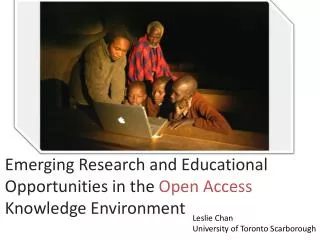
Emerging Research and Educational Opportunities in the Open Access Knowledge Environment Leslie Chan University of Toronto Scarborough
Territory size shows the proportion of worldwide research and development spending that is spent there. http://www.worldmapper.org/display.php?selected=165
Territory size shows the proportion of all scientific papers published in 2001 written by authors living there http://www.worldmapper.org/display.php?selected=205
Dominant Model of Knowledge Dissemination: From the Centre to Peripheries Centre Periphery “lost science” Perpetual the cycle of knowledge poverty and dependence
Knowledge as Public Goods Not Market Commodities
“Scientific findings do not belong to a country but to the whole world…” HernanRiquelme, EditorAgriculturaTécnica (Chile) July, 2008
Kaul et al. (1999:16) define global public goods as those which ‘tend towards universality in the sense that they benefit all countries, population groups and generations’
Why Journals? Registration Authentication and Quality Control Dissemination Reward - Citation Archiving
Reputation and Authority Management
Open Access is Disruptive Reconfiguring Quality and Reputation Reconfiguring Knowledge Domain and Representation
What OA is ABOUT • Equity of Access to Knowledge • Inclusive Participation • Expanded opportunities for teaching and learning
What OA is ABOUT • Improved Research Uptake and Impact • Improved Knowledge Translation and Knowledge Mobilization • Accounting for the social impact of research • Better Return on Research Funding
Knowledge Translation But this cycle is broken without access to Publications
OA is shifting the “centre” of knowledge production Decentralization
Dominant Model of Knowledge Dissemination: From the Centre to Peripheries “lost science” Perpetual the cycle of knowledge poverty and dependence
Open access enable Peer-to-Peer sharing … and new model of Knowledge creation, Sharing, and Dissemination
Dr. P.Balaram, IISc Bangalore India http://www.openoasis.org