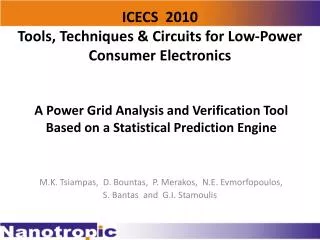
Statistical Prediction Engine for Low-Power Consumer Electronics Power Grid Analysis
130 likes | 250 Vues
This paper presents NanoPower, a tool for analyzing and verifying power grids in low-power consumer electronics, using a statistical prediction engine. The methodology addresses voltage drop and ground bounce issues, essential for ensuring signal integrity and timing correctness. The tool significantly reduces the need for exhaustive simulations by estimating worst-case voltage waveforms based on a limited set of random input vectors. With practical experimental results from a 65nm CMOS design, NanoPower promises accurate and efficient analysis, enhancing the design of modern integrated circuits.


Statistical Prediction Engine for Low-Power Consumer Electronics Power Grid Analysis
E N D
Presentation Transcript
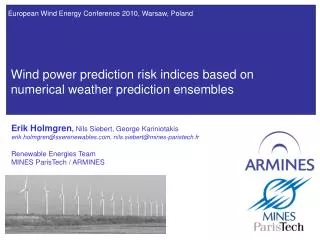
ICECS 2010 Tools, Techniques & Circuits for Low-Power Consumer Electronics A Power Grid Analysis and Verification Tool Based on a Statistical Prediction Engine M.K. Tsiampas, D. Bountas, P. Merakos, N.E. Evmorfopoulos, S. Bantas and G.I. Stamoulis
Outline • Motivation • Prior Work • NanoPower • Statistical Prediction Engine • Statistical Prediction Engine in multi mode design • Experimental results • Conclusion
Motivation • Voltage-drop on the power supply network • Ground bounce respectively on the ground network • Cells do not operate with the nominal power/ground supply • Signal integrity issues • Timing • Which is the worst case voltage drop ? • Designer would have to check the voltage drops that occur from the simulation of all possible input vector pairs . . . • Prohibitive amount of simulations for modern ICs that have hundreds of inputs
Prior Work • Vector-less pseudo dynamic methods. • Cannot determine with accuracy relationships between different sinks and formulate them as constraints . • Current constraints have the form of vague upper bounds and thus will only generate a pessimistic upper bound of voltage drop rather than a tight approximation . • These constraints only involve linear relationships between sink currents . • Vector-based methods . • Accurate in calculating voltage drop for this particular vector sequence • Prohibitively large number of all possible input vectors to simulate • No formal methods that provide a set of vectors which is guaranteed to excite the worst-case voltage drops
NanoPower (1/2) • Fast, accurate and reliable prediction of the worst case voltage waveforms over each tap-point of the power supply net of the IC. • Three lynchpin technologies (modules): • An accurate RLCK extraction engine to model the power supply network . • A high capacity digital (gate level) simulation engine with grid awareness . • A statistical prediction engine to estimate the worst case voltage waveforms .
NanoPower (2/2) • NanoPower works internally in an iteration loop between the digital simulator and the linear solver that simulates the power supply network . • 3-5 iterations between the two simulators are enough to converge to within 2-3% of SPICE .
Statistical Prediction Engine (1/3) • Independent approaches so far : • Mostly heuristic or over-simplified • Could not provide the accuracy needed for the design of deep-submicron ICs • A Statistical Prediction Engine based on the Extreme Value Theory • No need to identify and simulate the vector pairs that generate the worst-case voltage drop • Simulate the design for ~2500 random input vectors • Locate the maximal among the points of the sample space S resulted by the 2500 vectors • Shift the maximal points of the sample space S by a computed difference vector d and generate the excitation space D
Statistical Prediction Engine (2/3) • Confidence interval : • Define the interval of the voltage values for each time value in a period where the true worst-case voltage will fall into • Depend on the size of the input vectors set
Statistical Prediction Engine (3/3) • At each via correspond 3 waveforms : • 1 waveform giving the true worst case voltage • 2 waveforms determining the confidence interval
Statistical Engine in Multi Mode Designs • Modern ICs function in multiple modes of operation • The set of all possible input vectors is separated into subsets • Each vector subset forces the design operate in a specific mode • Each mode corresponds to a specific average current consumption • Solution : • A sufficient number of the input vectors for simulation to be part of the right most lobe
Experimental Test and Results • Design : H264 (~ 107000 standard cells ) • Technology : 65nm CMOS technology (TSMC) • Simulation vectors : 3000 (random) • Iterations : 3 • Nominal voltage : 1.0 V
Conclusion • Complete methodology encapsulated in a tool called NanoPower, for power grid analysis and verification • Able to calculate the voltage waveforms for all the vias in a placed and routed design • Predicts the worst case voltage waveforms at each via of the power supply network • Uses a very small, internally generated, subset of the overall possible input vectors set • The Statistical Prediction Engine used by NanoPower is based on solid mathematical foundation
Thank you Questions ?