Understanding Insertion Sort: Complexity, Steps, and Practical Applications
This comprehensive guide delves into the Insertion Sort algorithm, covering its implementation, time and space complexities, and the mechanics of counting operations during sorting. The article discusses the worst-case and best-case scenarios for comparison counts and introduces asymptotic analysis for time complexity, highlighting how performance changes with input size. It also stresses the importance of algorithm efficiency over hardware improvements, making it essential for programmers and computer scientists to understand insertion sort's practical viability in real-world scenarios.

Understanding Insertion Sort: Complexity, Steps, and Practical Applications
E N D
Presentation Transcript
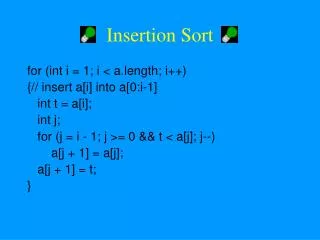
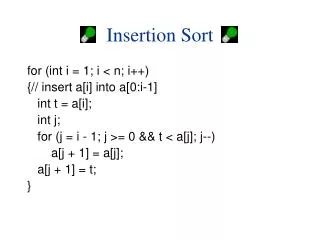
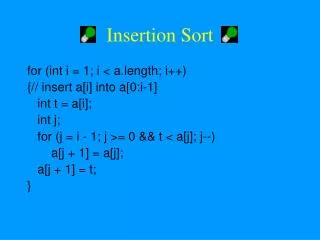
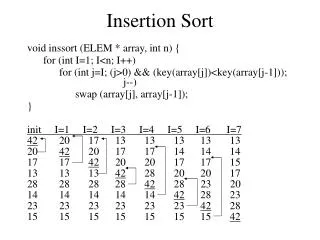
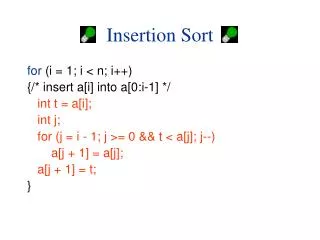
Insertion Sort for (i = 1; i < n; i++) {/* insert a[i] into a[0:i-1] */ int t = a[i]; int j; for (j = i - 1; j >= 0 && t < a[j]; j--) a[j + 1] = a[j]; a[j + 1] = t; }
Complexity • Space/Memory • Time • Count a particular operation • Count number of steps • Asymptotic complexity
Comparison Count for (i = 1; i < n; i++) {/* insert a[i] into a[0:i-1] */ int t = a[i]; int j; for (j = i - 1; j >= 0 && t < a[j]; j--) a[j + 1] = a[j]; a[j + 1] = t; }
Comparison Count • Pick an instance characteristic … n, n = a.length for insertion sort • Determine count as a function of this instance characteristic.
Comparison Count for (j = i - 1; j >= 0 && t < a[j]; j--) a[j + 1] = a[j]; How many comparisons are made?
Comparison Count for (j = i - 1; j >= 0 && t < a[j]; j--) a[j + 1] = a[j]; number of compares depends on a[]s and t as well as on i
Comparison Count • Worst-case count = maximum count • Best-case count = minimum count • Average count
Worst-Case Comparison Count for (j = i - 1; j >= 0 && t < a[j]; j--) a[j + 1] = a[j]; a = [1, 2, 3, 4] and t = 0 => 4 compares a = [1,2,3,…,i] and t = 0 => i compares
Worst-Case Comparison Count for (i = 1; i < n; i++) for (j = i - 1; j >= 0 && t < a[j]; j--) a[j + 1] = a[j]; total compares = 1 + 2 + 3 + … + (n-1) = (n-1)n/2
Step Count A step is an amount of computing that does not depend on the instance characteristic n 10 adds, 100 subtracts, 1000 multiplies can all be counted as a single step n adds cannot be counted as 1 step
Step Count s/e for (i = 1; i < n; i++)1 {/* insert a[i] into a[0:i-1] */ 0 int t = a[i]; 1 int j; 0 for (j = i - 1; j >= 0 && t < a[j]; j--) 1 a[j + 1] = a[j]; 1 a[j + 1] = t; 1 } 0 for (i = 1; i < n; i++) {/* insert a[i] into a[0:i-1] */ int t = a[i]; int j; for (j = i - 1; j >= 0 && t < a[j]; j--) a[j + 1] = a[j]; a[j + 1] = t; }
Step Count s/e isn’t always 0 or 1 x = sum(a, n); where n is the instance characteristic and sum adds a[0:n-1] has a s/e count of n
Step Count s/e steps for (i = 1; i < n; i++)1 {/* insert a[i] into a[0:i-1] */ 0 int t = a[i]; 1 int j; 0 for (j = i - 1; j >= 0 && t < a[j]; j--) 1 a[j + 1] = a[j]; 1 a[j + 1] = t; 1 } 0 for (i = 1; i < n; i++) {/* insert a[i] into a[0:i-1] */ int t = a[i]; int j; for (j = i - 1; j >= 0 && t < a[j]; j--) a[j + 1] = a[j]; a[j + 1] = t; } i+ 1 i
Step Count for (i = 1; i < n; i++) { 2i + 3} step count for for (i = 1; i < n; i++) is n step count for body of for loop is 2(1+2+3+…+n-1) + 3(n-1) = (n-1)n + 3(n-1) = (n-1)(n+3)
Asymptotic Complexity of Insertion Sort • O(n2) • What does this mean?
Complexity of Insertion Sort • Time or number of operations does not exceed c.n2 on any input of size n (n suitably large). • Actually, the worst-case time is Q(n2) and the best-case is Q(n) • So, the worst-case time is expected to quadruple each time n is doubled
Complexity of Insertion Sort • Is O(n2) too much time? • Is the algorithm practical?
Practical Complexities 109 instructions/second
Impractical Complexities 109 instructions/second
Faster Computer Vs Better Algorithm Algorithmic improvement more useful than hardware improvement. E.g. 2n to n3