
Genetics
E N D
Presentation Transcript
Genetics Why Do You Look Like You Do?
What You Should Learn From This Presentation • You should know the definition of each of the bold, underlined words • You should know the general theme of the presentation • We will go over the presentation as a group, be prepared to discuss it
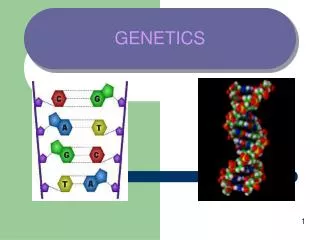
Genetics • Defined as the study of heredity.
History of Genetics • 10,000 years ago, farmers in Egypt bred wheat • 4,000 years ago, Asian horse breeders kept records of animal traits • Humans have been controlling the traits of crops and livestock since before the beginning of history
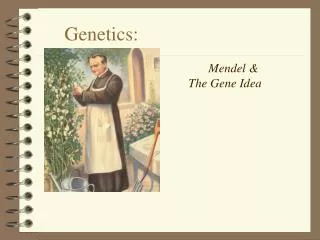
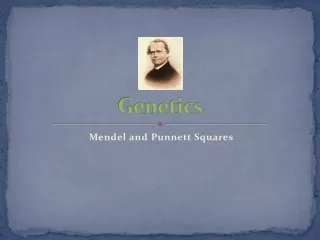
Gregor Mendel • 1822-1884 • Lived in Austria (now part of Czechoslovakia) • Was an Augustinian monk • Conducted breeding experiments in the monastery garden from 1856-1864 • Published in 1866 (just after Darwin was published) • No one cared until 35 years later (about 1900)
Gregor Mendel • Experiment consisted of keeping amazingly accurate records of the garden pea • He chose the pea plant because he could get pure strains that had been produced over years by gardeners • The strains had many different varieties with contrasting traits • He planted and kept records of over 30,000 plants
Gregor Mendel’s Results • Did you see a trend? • What is the final F2 ratio for each of the traits?
Gregor Mendel’s Results • If you didn’t, go back and take a look again • Notice that the trait in the F1 generation is always the larger number in the F2 generation
Gregor Mendel’s Results • If you figured out the F2 ratio, you should have noticed something else • Almost all of them are close to 3:1
Gregor Mendel’s Results • Why did all of the F2 generations have a three to one ratio when the F1 generation were all one trait? • Because the pure parents each gave a gene or “factor” to each of the F1 offspring and one of those genes were dominant over the recessivegene
Gregor Mendel’s Results • Yet, some of those F1 generations passed on the the genes to their F2 generations
Gregor Mendel’s Results • The F2 generation must have had some of the traits from the P1 generation, but we were unable to see the recessive traits. • They were masked or covered by the dominant trait.
Mendel’s First Principle • Principle of Dominance and Recessivness • Each trait is controlled by a pair of factors (chromosomes) • The dominant factor masks or hides the recessive factor
Genotype vs. Phenotype • Genotype describes the genetic make-up of the organism • The actual genes • Phenotype describes the physical make-up of the organism • What traits does the organism show
Mendel’s Second Principle • The Principle of Segregation • Heredity factors are determined by distinct factors • For each trait, an individual carries two factors for each trait • The two factors of each trait segregate and end up in separate gametes
Mendel’s Second Principle • Today, those factors are called genes • Part of the DNA • Each gene codes for one trait • Those are called alleles
Mendel’s Second Principle • If you did the cross below, what is the probabilty of each genotype?
Monohybrid Punnett Squares • Now you try some: • Tt x tt • Tt x TT • TT x tt