Organizing an Effective Assessment Consortium: Key Considerations
40 likes | 167 Vues
This presentation explores the essential elements in developing an assessment consortium, including defining the need for the organization, mission objectives, membership criteria, and structure. Key leadership roles, funding strategies, and communication methods are discussed to ensure the consortium's sustainability. Participants will learn about the importance of meeting frequency and record-keeping. Resources such as the New England Educational Assessment Network and the Reinvention Center are highlighted to support members in their formative processes.


Organizing an Effective Assessment Consortium: Key Considerations
E N D
Presentation Transcript
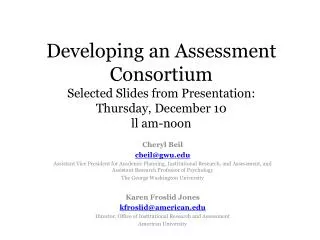
Developing an Assessment ConsortiumSelected Slides from Presentation:Thursday, December 10ll am-noon Cheryl Beil cbeil@gwu.edu Assistant Vice President for Academic Planning, Institutional Research, and Assessment, and Assistant Research Professor of Psychology The George Washington University Karen Froslid Jones kfroslid@american.edu Director, Office of Institutional Research and Assessment American University
Questions to consider when organizing an assessment consortium • Assessment: • What is the need for the organization? • Mission: • What are the desired outcomes? • Membership: • Who can join? • Organizational structure: • Should it be formal or informal? • Do you want to create by-laws?
Questions to consider when organizing (cont) • Leadership: • Who will initiate the start-up? • How will the organization be sustained over time? • Funding: • How will you fund activities? • Should there be membership fees? • Communication: • How will you communicate with one another? • Meeting: How often will you meet? • What will be achieved at the meetings? • Record keeping: • Should records be kept? • How will records be maintained?
Resources New England Educational Assessment Network (NEEAN) http://www.neean.org/ Reinvention Center http://www.reinventioncenter.miami.edu/ Washington Area Schools Learning and Assessment Network (WASLAN) Cheryl Beil – cbeil@gwu.edu Karen Froslid Jones – kfroslid@american.edu http://www.american.edu/provost/assessment/index.cfm