Download
1 / 17
170 likes | 292 Vues
This guide outlines best practices for cueing and tracking props in theatrical performances. It emphasizes the importance of using internal columns correctly and maintaining the sequence of cues. The document details how to identify and manage props with clear instructions on notation, including character movements and prop placements. Tips on grouping props and a set framework for notes reinforces efficiency in production. Additional scheduling insights and rehearsal report guidelines aim to enhance crew coordination and overall show execution.

E N D
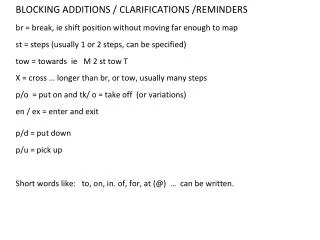
CUEING & Stand Bys • USE internal columns as described. (on Board) • Always in the correct order: SBLQ5 and LQ4 GO. • Always on a word or VIS, word with box under and line across to cueing column. • Abbreviations used: SB, LQ or LX, SQ, ASM, FOH, VIS, and • fby = followed by • imm = immediately • turn fast…. Place at the bottom of a page just before a page with cues at the top. • GROUPING CUES: • SB LX 4 • SQ 13 – 17 • LX 5 – 10 • LX 4 and • SQ 13 }GO
Write the prop in the prop column approximately ACROSS from where on the script page it is used, like blocking. They will correspond to the blocking numbers approximately. Determine WHO is moving the prop. Write this in lower case (except for the first letter) beside the prop. Determine WHERE the prop is coming from. Write this in lower case beside the prop CHARACTER name. Write “to“ beside that. Determine WHERE the prop ends up. This may be farther down the page. Write this beside the “to”. If it stays in the person’s hand for a while, write “hand”. KEEP THIS ON ONE LINE. Write compactly. EG: BRIEFCASE Jane floor to hand When the prop is put down, treat that as a new prop movement. EG2: BRIEFCASE Jane hand to table If an item is put INTO or ONTO another prop, ONLY the item being tracked is in CAPITALS. EG3: PAPER Jane briefcase to table NOTES: Some people like to put “from” after the character name before the first location. If you like that, and IF it helps, you CAN do it that way. It does take up more room. Be as specific as reasonable. Sometimes a group of props can be treated as a unit. Eg from various plays include: Food. Clothing. Tools. Files. Books. In these cases, a note in the KEY, or elsewhere can clarify that certain items will be treated as a group, unless otherwise noted. Sample: with two props trackings, two blockings, and 1 lighting cue Thank you, Anne Redish, S.M.
Schedules Overview Daily Per Assignment 10am – 6pm, and lunch after max 4 hrs, incl END of Day, Breaks 5 min per hour. Reports Rehearsal Reports / Notes Show Reports http://www.queensu.ca/drama/drama240/index_006.htm