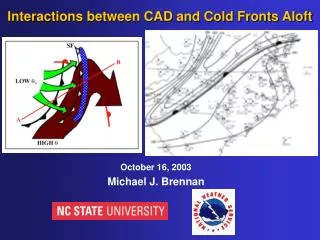
Interactions between CAD and Cold Fronts Aloft
160 likes | 331 Vues
This study explores the interactions between cold fronts aloft and cold-air damming (CAD), focusing on the impact of split front rainbands on CAD erosion. Using a case study from February 14, 2000, we analyze how these rainbands affect saturated and unsaturated cold domes. The findings highlight the importance of latent heat release in CAD erosion, as evidenced by numerical simulations and observational data. The study contributes to understanding the dynamics of CAD and informs future weather forecasting techniques.


Interactions between CAD and Cold Fronts Aloft
E N D
Presentation Transcript
Interactions between CAD and Cold Fronts Aloft October 16, 2003 Michael J. Brennan
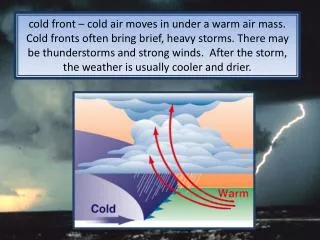
Potential impacts of cold fronts aloft on CAD CAD DOES NOT EXIST IN A VACUUM • Split front rainband moving across unsaturated cold dome could initiate or enhance hybrid in-situ CAD • Split front rainband moving across saturated cold dome could release sufficient latent heat causing CAD erosion via: • Hydrostatic pressure falls • Isallobaric wind effect • Inland movement of coastal front • Cold advection aloft weakening inversion
Case Study February 14, 2000 • Well-defined Split Front moved across the Mississippi Valley and Southeast U.S. • Diabatically Enhanced Classical CAD event eroding • Convection with split front moved across cold dome between 06Z and 12Z • Coastal front moved rapidly inland with temperature rise across Piedmont • RDU 6°C 06Z 12 °C 09Z
Numerical Sensitivity Test • Cold dome eroded as the split front rainband moved across the CAD region • Need to quantify the impact of latent heat release • Perform MM5 simulations with and without latent heat release • Will cold dome erode without LHR? • How large are differences?
MM5 Results at 12Z Full Dry P
What Have We Seen? • CAD cold dome decreased considerably between 06 and 12Z • Latent heat released over cold dome between 400 and 700 hPa • Moderate to heavy precipitation fell over the cold dome between 06 and 12Z
Conclusions • Observational data shows that cold dome eroded quickly between 06 and 12Z • MM5 simulations confirm that latent heat important in cold dome erosion as cold dome eroded more slowly in simulation without latent heat
For Further Reading • Brennan, M. J., G. L. Lackmann, and S. E. Koch, 2003: An analysis of the impact of a split-front rainband on Appalachian cold-air damming. Wea. Forecasting,18, 712-731. • BAMS Maproom Article: The Impact of a Split-Front Rainband on Appalachian Cold-Air Damming Erosion
Acknowledgements • Co-authors • Dr. Gary Lackmann and Dr. Steve Koch • NOAA CSTAR Grant • NWS CSTAR-I Offices • Raleigh • Wilmington • Morehead City • Greenville-Spartanburg • Wakefield