Download
1 / 23
230 likes | 356 Vues
This colloquium presents groundbreaking research on hypervelocity stars (HVS) ejected from the Galactic Center, led by Warren R. Brown from the Smithsonian Astrophysical Observatory. Collaborating with experts like Margaret Geller and Scott Kenyon, the study discusses the first predictions of HVS, their velocities, and the implications for understanding galactic dynamics and massive black holes. With 10 known HVSs detailing mass functions and orbits, the findings offer a unique window into stellar populations and the history of the Milky Way.

E N D
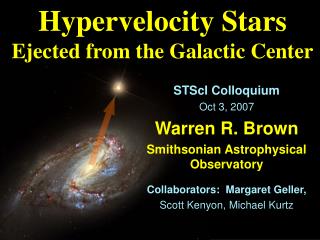
Hypervelocity StarsEjected from the Galactic Center STScI Colloquium Oct 3, 2007 Warren R. Brown Smithsonian Astrophysical Observatory Collaborators: Margaret Geller, Scott Kenyon, Michael Kurtz
Predictions NY Times 2/22/2005 Hills, 1988, Nature: prediction Hills, 1991, AJ: orbits Yu & Tremaine, 2003, ApJ: rates “It’s high time someone found it.” - Jack Hills SF Chronicle, 2/11/2005
The Milky Way Kaufmann
The Galactic Center http://www.mpe.mpg.de/ir/GC/prop.html
Three-body exchange Bromley 2005
An Unexpected Star Brown et al. (2005) • B9 main sequence star. • Solar metallicity. • g=19.8 thus d=110 kpc. • Travel time ~160 Myr.
Our Search for more Hypervelocity Stars O B F A G K M Fukugita et al (1996) Brown et al. (2006a, 2006b, 2007a, 2007b)
Spectroscopic Observationsof an Unusual Parameter Space Lowest Mass White Dwarf Extremely Metal Poor Galaxy log(O/H)+12 = 7.44 Kilic et al (2007a,b) Kewley et al. (2007) Brown et al. (2007c)
Radial Velocities HVSs Brown et al (2007b)
HVS: Ejection Model Bromley et al (2006); Brown et al. (2007a)
HVS: Main Sequence Stars Blue HB Horizontal Branch HVSs MS Kaufmann Brown et al. (2007b)
HVS: Locations and Travel Times Brown et al. (2007b)
HVS: Sky Distribution +90 60 30 120 240 300 360 180 0 60 -30 -60 -90 Brown et al. (2007a) - 300 0 +300 km/s
HVS: Space Density Brown et al. (2007b)
Theoretical Applications • Dark Matter Potential: Gnedin et al (2005), Yu & Madau (2007) • Binary Black Hole / origin: Baumgardt et al, Gualandris et al, Merritt, Levin, O’Leary & Loeb, Perets et al, Sesana et al., Lu et al., Svensson et al. • Stars orbiting the BH: Ginsburg & Loeb • Stellar Populations: Demarque & Virani, Kollmeier & Gould LISA Ginsburg & Loeb (2006)
Future Work • Discovery survey: MMT, Whipple 1.5m. • Spectroscopic identifications: VLT (Heber), WHT (Keenan). • Space velocities: HST (Gnedin). • Variability: MDM (Stanek). • Numerical simulations: (Bromley). • Unusual objects: more to come!
Conclusions • MBH = hypervelocity stars. • First HVS: B star +850 km/s. • Now 10 known HVSs. • HVSs a unique window on the Galactic Center: • Mass function of stars • In-fall history • Massive black hole (binary?) NY Times
Mass Function of Stars We Observe: 7 HVS in 6000 deg2 ~50 3-4 Msun HVSs Salpeter 16 3-4 Msun stars Predicted: 2000 HVSs (Yu & Tremaine) Arches ~100 3-4 Msun stars NASA HST