Understanding the Dualism of Nazi Germany: Functionalist vs. Structuralist Perspectives
This analysis delves into the complexities of Nazi Germany's governance through the lens of both Functionalist and Structuralist theories. While Functionalists highlight the opportunistic nature of Hitler's leadership, emphasizing chaotic overlaps between state and Nazi organizations, Structuralists stress the shaky economic recovery and polycratic regime under Hitler. Both perspectives provide insights into the power struggles, confusion, and conflicts among Nazi officials, revealing how these dynamics influenced policy-making and governance during a tumultuous era in German history.

Understanding the Dualism of Nazi Germany: Functionalist vs. Structuralist Perspectives
E N D
Presentation Transcript
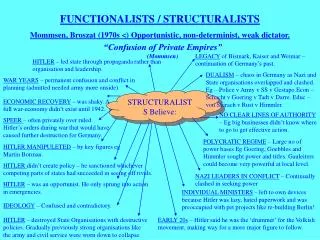
FUNCTIONALISTS / STRUCTURALISTS Mommsen, Broszat (1970s <) Opportunistic, non-determinist, weak dictator. “Confusion of Private Empires” (Mommsen) LEGACY of Bismark, Kaiser and Weimar – continuation of Germany’s past. HITLER – led state through propaganda rather than organisation and leadership. DUALISM – chaos in Germany as Nazi and State organisations overlapped and clashed. Eg – Police v Army v SS v Gestapo.Econ – Schacht v Goering v Tadt v Darre. Educ – von Shirach v Rust v Himmler. WAR YEARS – permanent confusion and conflict in planning (admitted needed army more onside) STRUCTURALISTS Believe: ECONOMIC RECOVERY – was shaky. A full war-economy didn’t exist until 1942. NO CLEAR LINES OF AUTHORITY – Eg big businesses didn’t know where to go to get effective action. SPEER – often privately over ruled Hitler’s orders during war that would have caused further destruction for Germany. POLYCRATIC REGIME – Large no of power bases Eg Goering, Goebbles and Himmler sought power and titles. Gauleiters could become very powerful at local level. HITLER MANIPULETED – by key figures eg Martin Borman. HITLER didn’t create policy – he sanctioned whichever competing parts of states had succeeded in seeing off rivals. NAZI LEADERS IN CONFLICT – Continually clashed in seeking power HITLER – was an opportunist. He only sprung into action in emergencies. INDIVIDUAL MINISTERS – left to own devices because Hitler was lazy, hated paperwork and was preoccupied with pet projects like re-building Berlin! IDEOLOGY – Confused and contradictory. HITLER – destroyed State Organisations with destructive policies. Gradually previously strong organisations like the army and civil service were worn down to collapse. EARLY 20s – Hitler said he was the ‘drummer’ for the Volkish movement, making way for a more major figure to follow.
INTENTIONALISTS Bullock, Bracher, Fest, Shirer 1945-c.1970s Planned, Determinist, Totalitarianism, Strong Dictator. “Nazism was Hitlerism” (Bracher) PLANNED rise to power – policy of legality after Munich confused everyone, achieved broad-based support. DURING WAR – Persuaded Austrian Chancellor Schuschnigg to allow Nazi to enter Gov – Feb ‘38. Persuaded Czech President Hacha to allow Nazis into country. Nullified Anglo-German Naval Agreement and planned invasion of Poland, once Britain had given ultimatum. TOTALITARIANISM – one leader, one party, one ideology. FUHRER PRINZIP – All powerful leader. INTENTIONALISTS Believe: ALL POLICIES – went through Hitler, his word was law. ARMY – swore to die for him and to protect him. CULT OF LEADERSHIP – charismatic leader underpinned by propaganda Eg Nuremburg Rallies. WAR CRIMES TRIALS – Nazi officials declared they had simply “followed orders” WORSHIPPED by other leading Nazis. ECONOMY – strong, as unemployment was virtually nil and Germany was preparing for autarky. POWER STRUGGLES – were allowed between ministers to gain more power for Hitler. IDEOLOGY – strong core of War, Racial Extermination and Fuhrer Prinzip. ELIMINATED OPPOSITION: EXTERNALLY – 1933 Enabling Act, Law Against Formation of Parties, becoming Fuhrer. INTERNALLY – 1934 Night of the Long Knives. TERROR HOUSE – SS, Gestapo and to some extent SA all under Hitler’s control and in turn controlled masses through fear. EDUCATION SYSTEM – strong, from teachers, to students in the class room and the Hitler Youth. FEW REBELLIONS – Generally people supported his policies and ultimately supported him.