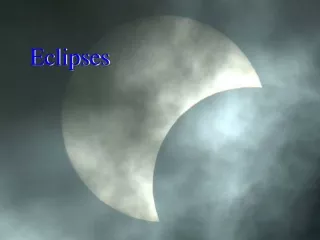
Eclipses
Eclipses occur when the Earth, Moon, and Sun align perfectly. A lunar eclipse happens when the Earth casts its shadow on a full moon, resulting in a stunning reddish hue. In contrast, a solar eclipse occurs when the New Moon obscures the Sun, causing darkness during the day. Eclipses are rare due to the Moon’s tilted orbit, which means they only happen about twice a year. Discover more about these fascinating events and find links to NASA’s lunar and solar eclipse pages for the latest information and viewing opportunities.

Eclipses
E N D
Presentation Transcript
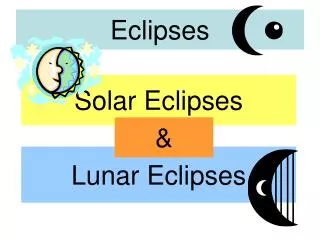
Eclipses Lunar and Solar
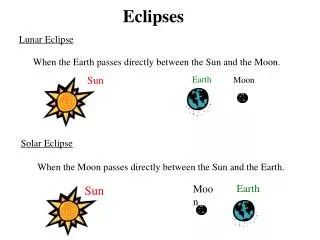
When can we see an ECLIPSE? When the Earth, Moon, and Sun are perfectly aligned.
LUNAR eclipse • The Earth’s shadow falls on the FULL moon • Moon turns dark red
LESEM S Lunar Eclipse is Sun Earth Moon E SHADOW Have you heard of Le Sem? M
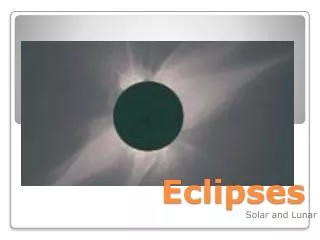
SOLAR eclipse • NEW Moon blocks out the sun and casts a shadow on Earth • Sky darkens in middle of the day!
SESME S Solar Eclipse is Sun Moon Earth M SHADOW “Darkness, says me!!!” E
Why don’t we see eclipses every month? • The moon’s orbit is TILTED 5° • Only when E-M-S are perfectly in line will an eclipse be possible to see (2x per year)
Science is Awesome! • NASA Lunar Eclipse Page • NASA Solar Eclipse Page • August 21, 2017