Download
1 / 16
160 likes | 304 Vues
This overview explores the rich tapestry of Southeast Asian history, focusing on the Khmer Empire (802-1431 AD) in Cambodia, its innovations in hydraulic engineering, and the grandeur of Angkor Wat. It examines the influences of Indian culture, including Hinduism and Buddhism, and the subsequent rise and fall of the Khmer. The narrative also delves into Vietnam’s long-lasting struggle for independence, its Confucian roots, and legendary figures like the Trung Sisters. Further, it highlights the early influences in Myanmar and the establishment of the Thai kingdom, illustrating the interconnectedness of these Southeast Asian nations.

E N D
SOUTHEAST ASIA Khmer, Vietnam, Myanmar and Thai
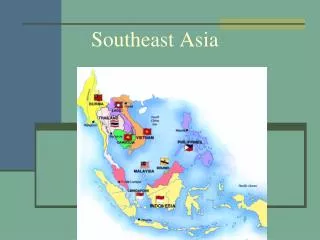
S.E. Asia • Includes Myanmar, Thailand, Vietnam, Laos, Cambodia, Malaysia, Singapore, Brunei, Indonesia & Philippines
S.E. Asia (cont’d) • Heavily influenced by India: Sanskrit, Hinduism & Buddhism, architecture, laws & political ideas
The Khmer, 802-1431 A.D. • In Cambodia, conquered much of Laos, Thailand & Vietnam • Hindu-Buddhist empire • Capital at Angkor
The Khmer (cont’d) • Hydraulic engineering allowed irrigation & to harvest rice 3x’s per year • Used wealth from crops for construction projects: hundreds of temples, roads, reservoirs, irrigation canals, harbors & hospitals • Rulers known for splendor of court -- presented selves as incarnations of Hindu Gods to enhance their power
King Suryavarman &Angkor Wat • 1100’s height of power • King Suryavarman built Angkor Wat temple to glorify Hindu God Vishnu and himself • Temple nearly 1 square mile big
Fall of The Khmer • Cost of building Angkor Wat weakened the kingdom • Rebellions against the Khmer & infighting within royal family crippled the empire • In 1431 A.D., the Thai captured the capital & ended Khmer rule
Vietnam • Dominated by China for more than 1000 yrs • Absorbed Confucianism, Daoism & Buddhism from Chinese • Govt similar to China, including civil service exams based upon Confusianism
Vietnam (cont’d) • Believed in “animism” = that spirits inhabit living & nonliving things • Building “dinhs” = spirit houses in each village, a home for the guardian spirit of the village • Continuously fought China for independence
Vietnam (cont’d) • The Trung Sisters rode atop elephants & led a successful revolt against China in 39A.D., & gained independence for 2 yrs • When later defeated by Chinese, sisters drown selves
Vietnam (cont’d) • 938 A.D., Ngo Quyen lead Vietnamese to defeat Chinese warships in the Battle of the Bach Dang River -- China countered & invaded Vietnam • Vietnamese date their independence from defeat of warships
Vietnam (cont’d) • To keep peace with China and so as not to be invaded, Vietnam agreed to send tribute (gifts) to the Chinese emperor
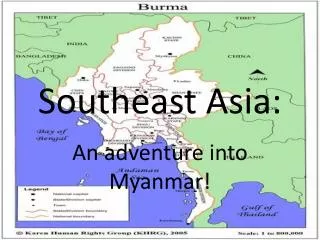
Myanmara/k/a Burma • First settled by 2 groups of people: the Mons (south) & the Tibeto-Burmans (along Irrawaddy River in the north) • Both were Buddhist & adopted Indian culture
Myanmara/k/a Burma • 500 B.C., the Tibeto-Burmans dominated & pushed the Mons southward • Tibeto-Burmans set up capital called Pagan, center for Buddhist learning & culture with temples & monasteries • 1200’s, Mongols under Kublai Khan captured Pagan; many Burmans moved south but remained ununited
The Thai • The Thai were originally from China • 1238 A.D., established Thai kingdom at Sukhothai; kingdom only lasted 100 yrs. • King Ramkhamhaeng ruled during golden age
Thai King Ramkhamhaeng • Thai developed alphabet & writing system based upon Khmer • Followed Buddhism & built beautiful temples