Fin Design for Maximum Thermal Dissipation
260 likes | 374 Vues
This study focuses on the design of a fin system that effectively dissipates heat from an engine casing using Aluminum Alloy and Carbon Steel. The primary objective is to analyze which material offers superior thermal performance. By simulating operating conditions and applying various boundary conditions in a Computer-Aided Engineering environment, we assess temperature distributions for different fin designs. The results indicate that the Aluminum fin system provides significantly greater heat transfer efficiency, enhancing the safety and performance of the motor casing by reducing overheating risks.


Fin Design for Maximum Thermal Dissipation
E N D
Presentation Transcript
Fin Design for Maximum Thermal Dissipation ME 450: Computer Aided Engineering Analysis Instructor: Dr. Nema Group Members: Wei-Yuan Chu, Brad Holtsclaw, Nick Metzger, Breanne Walters
Objectives • Maximize Thermal Dissipation by Designing a Fin System that will Draw Heat Away from the Engine Casing • Using Aluminum Alloy and Carbon Steel as Materials, we will analyze which material makes a better fin.
Introduction • Engine is used to run a small blower • It is assumed that the motor casing will be subjected to cooling by a fan or other suitable ventilation. • Main area of concern is drawing heat into the fin system in order to dissipate it into the air.
Complete Assembly Area of Interest
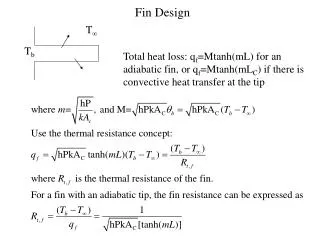
Theoretical Background (Cont.) Where: Assuming Convection Heat Transfer @ x=L
Model Details (Solid Modeling) Solid Models were created in Pro-Engineer and Converted to IGES Files to Import into Ansys
Model Details (Type I) • SOLID 92 Element Type • 5,829 Elements • 10,706 Nodes
Model Details (Type II) • SOLID 92 Element Type • 16,196 Elements • 29,355 Nodes
Model Details (Type III) • SOLID 92 Element Type • 16,196 Elements • 29,355 Nodes
Boundary Conditions • Temperature of 65.56oC applied to Internal Surface to Simulate Operating Conditions
Boundary Conditions (Cont.) • Ambient Temperature of 10oC • Film Coefficient of 100 W/m*oC (for cooling airspeed of 10 m/s)
Results and Discussion:S.S. Temperature Distribution (Type I) – Steel Top Fins • Carbon Steel Top Fins • Max. Temp. in Fins is 55.078oC
Results and Discussion: S.S. Temperature Distribution (Type I) – Aluminum Top Fins • Aluminum Top Fins • Max. Temp. in Fins is 60.218oC
Results and Discussion: S.S. Temperature Distribution (Type II) – Steel Top Fins • Steel Top Fins • Max. Temp. in Fins is 50.885oC
Results and Discussion: S.S. Temperature Distribution (Type II) – Aluminum Top Fins • Aluminum Top Fins • Max. Temp. in Fins is 55.777oC
Results and Discussion: S.S. Temperature Distribution (Type III) – Steel Top and Side Fins • Steel Top and Side Fins • Max. Temp. in Fins is 50.885oC
Results and Discussion: S.S. Temperature Distribution (Type III) – Aluminum Top and Side Fins • Aluminum Top and Side Fins • Max. Temp. in Fins is 55.777oC
Results and Discussion: Transient Response(Type III) – Aluminum Top and Side Fins
Results and Discussion: Top Fin Design Comparison Solutions STEEL ALUMINUM
Results and Discussion: Side Fin Design Comparison Solutions STEEL ALUMINUM
Results and Discussion: Heat Transfer Comparison for Type III Design Aluminum Steel
Impact Statements • The Addition of Fins will Aid in the Heat Dissipation from the Motor Casing, making the Part More Safe for General Use • Motor Casing with Type III Fins Will have a Reduced Surface Temperature and Less of a Chance of Overheating the Interior Electronics and Causing a Fire
Conclusions • Total Heat Transferred from Aluminum Fin is 245.83 W Greater than that from the Steel Fin. • Efficiency for Aluminum Fin is Greater than that of Steel. • Aluminum is the Best Choice for the Fin Material.
References Nematollahi, Khosrow. "Oncourse, ME 450." Scheduled Reading and Assignments. IUPUI. 23 Apr 2007 <https://oncourse.iu.edu/access/content/user/knematol/Filemanager_Public_Files/ME450LectureNotesCh13r>. Incropera, Frank, David Dewitt, and Theodore Bergman. Fundamentals of Heat and Mass Transfer. 6th. Hoboken NJ: Wilet & Sons, 2007. Rengifo, Gustavo. "Oncourse, ME 546." ME 546 Resources, Project #1. IUPUI. 23 Apr 2007 <https://oncourse.iu.edu/access/content/group/SP07-IN-ME-546-26532/Lab%20Projects/Project%>.