Lecture on Anemometer
160 likes | 653 Vues
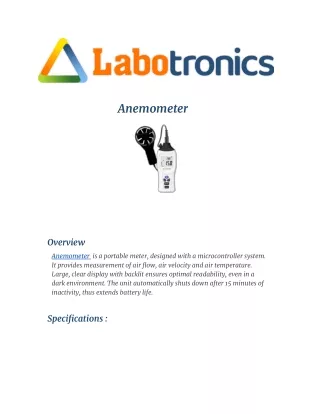
This lecture explores the anemometer, an instrument designed to measure wind speed. Invented in 1450 by Italian architect Leon Battista Alberti and later refined by Robert Hooke in 1664, it utilizes rotating cups to gauge wind velocity. As wind flows, these cups spin a rod connected to a dial that displays the speed. While specialized tools provide precise measurements, wind speed can also be estimated through observation. This guide delves into the working mechanism, historical significance, and various types of anemometers prevalent today.


Lecture on Anemometer
E N D
Presentation Transcript
Lecture on Anemometer www.assignmentpoint.com
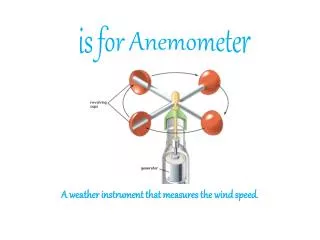
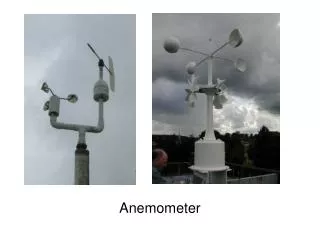
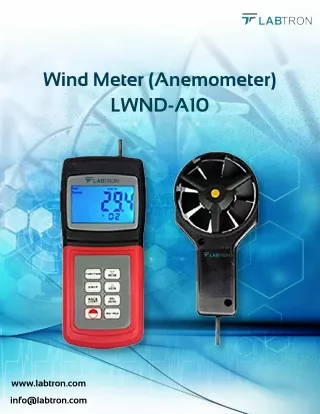
An Anemometer measures wind speed. The cups catch the wind, turning a dial attached to the instrument. The dial shows the wind speed. Wind speed can be estimated without special tools by observation. www.assignmentpoint.com
Anemometers www.assignmentpoint.com
Where was the anemometer invented? • In 1450, the Italian art architect Leon Battista Alberti invented the first mechanical anemometer; in 1664 it was re-invented by Robert Hooke (who is often mistakenly considered the inventor of the first anemometer). www.assignmentpoint.com
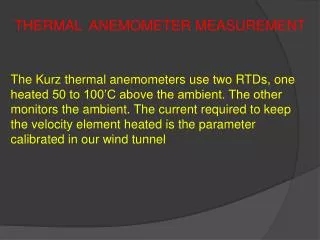
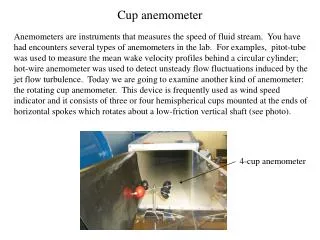
How does the anemometer works? • The arms are attached to a vertical rod. As the wind blows, the cups rotate, making the rod spin. The stronger the wind blows, the faster the rod spins. The anemometer counts the number of rotations, or turns, which is used to calculate wind speed. www.assignmentpoint.com
How do you measure the wind speed and direction? • Wind speed and wind direction can be measured with a variety of tools. The most common, included with complete home weather stations, is the anemometer, which typically consists of a rotating vane to measure direction and a shaft with cups attached that spins with the wind to measure its speed. www.assignmentpoint.com