Understanding Covalent Bonds: Formation, Properties, and Naming
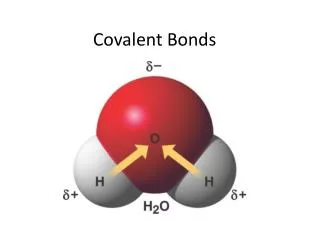
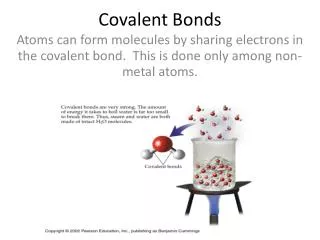
Covalent bonds are formed when two nonmetal atoms share one or more pairs of electrons, leading to stable molecules. This process results in different types of covalent bonds: single (2 shared electrons), double (4 shared), and triple (6 shared). Covalent compounds often have lower melting and boiling points, do not conduct electricity, and exist as gases or liquids at room temperature. Proper naming and writing of formulas utilize prefixes to denote the number of atoms present, as seen in carbon dioxide (CO2) and dinitrogen tetroxide (N2O4).

Understanding Covalent Bonds: Formation, Properties, and Naming
E N D
Presentation Transcript
Types of bonds • Ionic bonding results from electrostatic attractions among ions, which are formed by the transfer of one or more electrons from one atom to another. • Covalent bonding results from sharing one or more electron pairs between two atoms. • Metallic bonding results in a sea of electrons between two cations • http://www.picsearch.com/info.cgi?q=ionic%20bonds&id=IHgxbdtO5lawBR9zy6jqpq1E_2Jt6okckgQmu4NAeQI
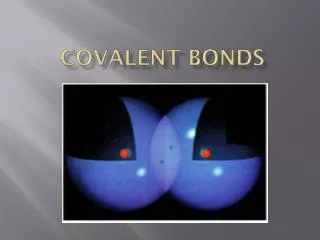
What makes a covalent bond? • Covalent bonds are formed when atoms share electrons. • Two nonmetals • If the atoms share 2 electrons a single covalent bond is formed. • If the atoms share 4 electrons a double covalent bond is formed. • If the atoms share 6 electrons a triple covalent bond is formed.
Properties • Lower melting and boiling points • Molecules don’t interact much • Gases or liquids at room temp • Don’t conduct electricity • No ions so no charges • Flexible • Molecules move around
Naming covalent compounds • Two elements • Use prefixes to tell how many atoms of each element are present • Example: Carbon Dioxide CO2 Mono is never used for the first element
Writing formulas • The prefixes simply tell you the subscript for each element • Example: dinitrogentetroxide N2O4 Mono (1 is not written) Drop the vowel ending of the prefix if the prefix ends in a vowel and the element begins with a vowel.