Wintertime PM2.5 Modeling in Utah: Impacts, Standards, and Future Projections
This presentation by Lance Avey from the Utah Division of Air Quality discusses wintertime PM2.5 levels in Utah, analyzing their composition, including components like organic carbon and ammonium nitrate. It highlights the EPA's revised NAAQS for PM2.5 and outlines the State Implementation Plan’s critical elements, such as emissions inventories and attainment demonstrations. Additionally, it addresses the effects of future emissions changes due to population growth, technological advancements, and cleaner vehicles on PM2.5 levels, underscoring the importance of effective control strategies.

Wintertime PM2.5 Modeling in Utah: Impacts, Standards, and Future Projections
E N D
Presentation Transcript
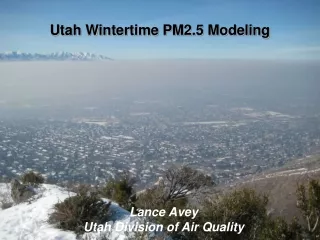
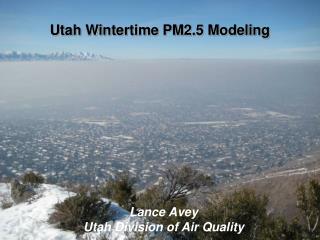
Utah Wintertime PM2.5 Modeling Lance Avey Utah Division of Air Quality
PM2.5 Speciation Dust 2% Elemental Carbon 5% Other 5% Organic Carbon 20% Ammonium Nitrate 58% Ammonium Sulfate 9% NOx + VOCs HNO3 (nitric acid) HNO3 + NH3 NH4NO3 (particulate)
NAAQS for PM2.5 • EPA revised the NAAQS for PM2.5 in December of 2006 • 24-hr standard was lowered from 65 micrograms per cubic meter (µg/m3) to 35 µg/m3 • Annual standard was retained at 15 µg/m3 • Retained the 24-hr standard for PM10 at 150 µg/m3
State Implementation Plan • Basic Elements include: • Modeled Attainment Demonstration (with chemistry) • Emissions Inventories • Emission Limits • Attainment Dates (2 – 7 years after SIP)
Retrospective Modeling • Replicate the meteorological, emissions, and chemistry of past high PM2.5 episodes • In the future, the same meteorology and chemistry will cause high PM2.5 episodes • Future emissions will change • Population Growth, new technologies, cleaner vehicles • Allows DAQ to evaluate how future changes in emissions (and control strategies) effect PM2.5
Emissions Point, Area, Mobile
UDAQ RetrospectiveWRF • 36/12/4 km Horizontal Domain • 37 vertical layers • 1st layer at ~ 12 meters • 10 layers below 250 meters • Initialization uses 12km-NAM Re-analysis • Pleim-Xiu LSM & Surface Layer, ACM2 PBL • Simulations were ran in 5.5 day segments • Observational and Analysis Nudging
Modeling Domain 4km x 4km
WRF Output 2010 Jan 04 – Midnight Local Time
CMAQ Nitrate (ug/m3) 2010 Jan 04 – Midnight Local Time
Future Year Modeling • Same Meteorology • Same Chemistry • Changes in Emissions