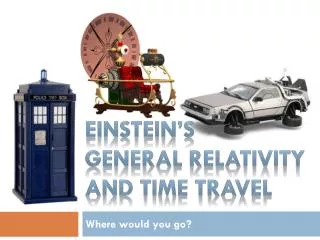
Einstein’s General Relativity and Time Travel
70 likes | 206 Vues
This article dives into the fascinating interplay between Einstein's theory of general relativity, the concept of time travel, and our understanding of time itself. It discusses the historical view of absolute time as defined by Sir Isaac Newton compared to Einstein's revelation of relative time. Discover how time can vary for different observers due to relative motion and gravity. With groundbreaking experiments using cesium atomic clocks, we explore the possibility of time travel and the conditions needed to achieve it. Could super-fast ships or intense gravitational fields be the key?


Einstein’s General Relativity and Time Travel
E N D
Presentation Transcript
Einstein’sGeneral Relativityand Time Travel Where would you go?
How We Think of “Absolute Time” • Time is a force of nature separate from us that moves at the same rate for all of us Sir Isaac Newton’s“Absolute Time”(1600’s) • Yes, sometimes we perceive time moving slow or fast but that’s just a trick our mind plays on us • Time Travel is Impossible!
Einstein Discovers “Relative Time” in 1905 • Time, Space, and Gravityare intertwined (not separate)and can affect each other! • Time is relative and can move at different rates for different people! This means your present isn’t necessarily my present. • Time Travel is Possible!
The Time-Space-Gravity Demo Time(clock) Space(speed) Gravity(weight)
How Could You Possibly Test This? Cesium Atomic ClockAccurate to within 1 second over 100 million years! Add A Space Shuttle Clock(orbiting the Earth at 17,000mph + near orbit microgravity) Start With A Ground Clock (stationary, normal Earth Gravity) Space Shuttle Clock ran slower than the ground clock! Confirming time travel!
So all you need to Time Travel is… OR A Really Fast Ship! Super Strong Gravity!