Download
1 / 3
30 likes | 143 Vues
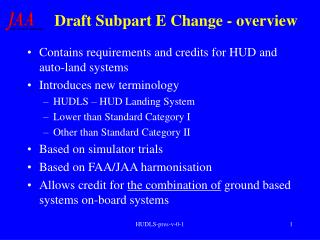
This document outlines the key changes to Subpart E based on harmonization results between the FAA and JAA. The FAA is set to amend TERPS and operational specifications, incorporating insights from various aviation authorities and organizations. New concepts such as the stabilized approach and Continuous Descent Final Approach (CDFA) are introduced. The updates ensure compliance with ICAO standards and propose a 3-year implementation period for new operating minima. Notable changes include adjustments to minima and allowances for new technology, aimed at enhancing flight safety and operational efficiency.

E N D
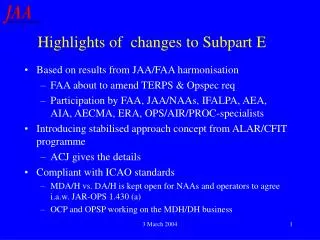
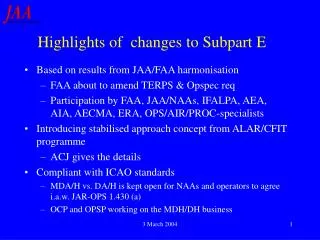
Highlights of changes to Subpart E • Based on results from JAA/FAA harmonisation • FAA about to amend TERPS & Opspec req • Participation by FAA, JAA/NAAs, IFALPA, AEA, AIA, AECMA, ERA, OPS/AIR/PROC-specialists • Introducing stabilised approach concept from ALAR/CFIT programme • ACJ gives the details • Compliant with ICAO standards • MDA/H vs. DA/H is kept open for NAAs and operators to agree i.a.w. JAR-OPS 1.430 (a) • OCP and OPSP working on the MDH/DH business 3 March 2004
Highlights of changes to Subpart E (2) • The concept of CDFA ( Continuous Descent Final Apch) • Includes SAp (stabilised in terms of configuration/energy) • Includes a number of conditions • Includes the majority types of NPAs • Minima based on a concept/formulae: RVR = HAT/tg x (apch slope angle) - length of apch lights • Single table minima for Cat I/APV/NPA • Some changes of system minima, e.g. NDB raised to 350 ft • Lowest RVR of 550 m is kept, but use of RVR < 750 m is subject to some conditions, like use of A/P, F/D, HUD, etc 3 March 2004
Highlights of changes to Subpart E (3) • Stabilised approach mandated immediately • 3 years implementation period proposed for new operating minima due to OM & training issues • Penalties in RVR suggested until flying continuous descent final approaches • Allowing for new technology, e.g. HUD, GLS • Some alleviations for qualification of Cat III operations in relation to aeroplane/runway combinations • Some alleviations in Cat II/III training/qualification i.a.w. an OPS/FCL workshop results 3 March 2004