The Adolescent Brain
The adolescent brain undergoes significant evolution from ages 11 to 24, marked by an amygdala-driven, dopamine-sensitive framework that often results in heightened risk-taking and sensation-seeking behaviors. Key insights include the emotional intensity perceived by adolescents, the need for emotional safety, and the effects of lifestyle on brain development. With effective support from adults, adolescents can manage their emotional and cognitive changes better. This resource outlines the brain's evolution, challenges like substance use, gender differences, and emphasizes the importance of nurturing healthy development during this critical period.

The Adolescent Brain
E N D
Presentation Transcript
The Adolescent Brain Janet Matthews and Sarah Ramowski
Adolescent Evolution • ages 11 – 24 • Amygdala driven • Dopamine sensitive • Filter deficient • Risk prone • Sensation-seeking • Peer presence
Learning Ladder • Novice to expert Unconscious; competent Conscious; competent Conscious; incompetent Unconscious; incompetent
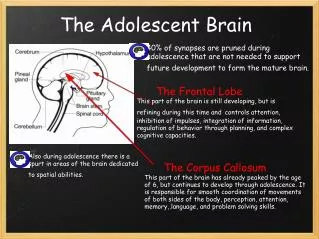
Functional Evolution • Amphibian ~ Mammal • Autopsy ~ MRI • Primitive ~ Cerebral • Myelination
Emotional evolution • Affect • Shame ~ Guilt • Eustress ~ distress • Self talk emerges • Puberty ~ maturity
Adolescent Prevention Messages • Repetition • Fiber tract sculpting • Myelinates tracts • Pruning • Lifestyle impact • Increase voluntary control • Brain > Mind
The Big Picture • Adolescence is incredibly exciting time in brain development…therefore, also crucial that we nurture adolescent brains • Change our thinking about adolescents and risk taking
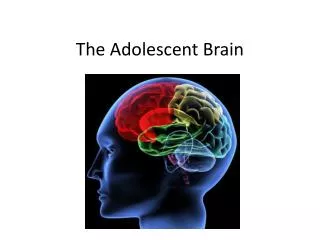
How Do We Know What We Know? • MRI pictures show brain structures & sites of activity • New: DTI (diffusion tenor imaging) shows color images of neural fibers that transmit signals
The Physical • “AA” sites in brain – “Appearance Attractiveness” – 5x higher in youth than adults
The Emotional • Compared to adult brain, adolescent brain perceives emotions at 2-4x the intensity • Adolescents have 3 basic needs in coping with emotional intensity: 1) Listen; 2) Validate; 3) Support good choices • Adults often use 3 “D’s”: 1) Deny 2) Diminish 3) Disrespect
Emotional Safety • Setting the rules for emotional safety is crucial for promoting safety and healthy positive development among youth. • Compliments given to adolescents should be very careful – based on behavioral observations
Problem Solving • THP helps adults cope in crisis (calming effect), but in youth it causes anxiety/apprehension • “You need to calm down” is not effective in the moment when THP is activated • Avg 13.6 yrs when youth shift to willingness to engage adults in open conflict – this is NORMAL development
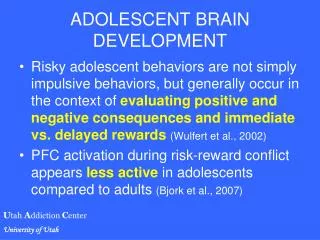
Risk Taking • Risk Reward in Adolescent Brains via Nucleus Accumbens • Teens need safe risk-taking opportunities • Preventing risk-taking: here and now of consequences, not future
Risk Taking & the Internet • Perspective taking • Future thought • Online disinhibition effect • Virtual Mystery Tour: healthysexedu.blogspot.com
Substance Use • AvoidBoredom • 10 – 14 is key window to avoid for alcohol use • Brain is beyond plasticity window, and this is the time where cell mapping & migration process is the highest
Substance Use • Pathways activated by alcohol in < 22 y.o. brains can remain excited for 48 hrs after drinking, brain cells self-destruct • Having a male older sibling, especially for boys, is a risk factor for trying drugs/alcohol (often the “first route” into drugs/alc). • Effects of marijuana on brain are increasingly unknown (depending on delivery system)
Gender Differences • Female brains have average 29% more verbal capacity (relative to brain size overall) vs. male brains • Are girls “more emotional” than boys? No. • Positive self-esteem between ages 9-10 and 13-14: for boys it drops 12-20%, for girls it drops 20-38%
Take Away Messages • Emotions, reasoning, and decision-making are all under construction during adolescence • Time of vulnerability AND capability • Adults can help by de-personalizing teenage behavior • Adolescents need positive adult framing & support for making good choices
Resources • The Adolescent Brain: A Work in Progress. The National Campaign to Prevent Teen Pregnancy.www.teenpregnancy.org/resources/reading/pdf/BRAIN.pdf • Brizendine, Luann. The Female Brain. • The Dana Foundation. www.dana.org (new relevant research in brain development) • The Brain Connection. www.brainconnection.com