Emerging Trends Shaping the Future of Corporate Landscape by 2025
10 likes | 143 Vues
This analysis explores nine key trends influencing the future corporate landscape by 2025. Macro-economic patterns reveal a convergence of Asian (ex-Japan) and European GDPs, while new consumer demographics emerge, driven by a billion households with rising incomes. Social and environmental challenges are highlighted, including the overburdened public sector and the urgent need for corporate responsibility amid limited resources. Business dynamics are shifting as corporations evolve and new knowledge collaboration emerges, reshaping industry structures and underscoring the importance of innovation and sustainability.


Emerging Trends Shaping the Future of Corporate Landscape by 2025
E N D
Presentation Transcript
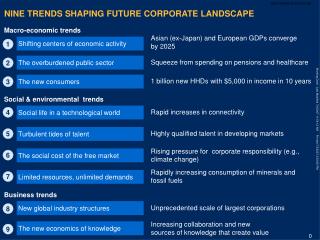
8 • 9 NYO-AAA123-20070702- NINE TRENDS SHAPING FUTURE CORPORATE LANDSCAPE • Macro-economic trends • Asian (ex-Japan) and European GDPs converge by 2025 • Shifting centers of economic activity 1 • The overburdened public sector 2 • Squeeze from spending on pensions and healthcare • The new consumers 3 • 1 billion new HHDs with $5,000 in income in 10 years • Social & environmental trends • Social life in a technological world 4 • Rapid increases in connectivity • Turbulent tides of talent 5 • Highly qualified talent in developing markets • Rising pressure for corporate responsibility (e.g., climate change) • The social cost of the free market 6 • Rapidly increasing consumption of minerals and fossil fuels • Limited resources, unlimited demands 7 • Business trends • New global industry structures 8 • Unprecedented scale of largest corporations • Increasing collaboration and new sources of knowledge that create value • The new economics of knowledge 9