Towson University Construction & Professional Development
170 likes | 294 Vues
Discover the evolving world of modular construction in this comprehensive overview featuring insights from Ryan's journey and the current landscape of the industry. Explore its applications across various sectors, including universities, hospitals, and military facilities. Learn about the benefits of modular construction, such as accelerated project timelines and reduced site disturbances. Understand the construction process, site concerns, and compliance with design and safety standards. This session highlights real-world project examples and concludes with a Q&A session for deeper engagement.


Towson University Construction & Professional Development
E N D
Presentation Transcript
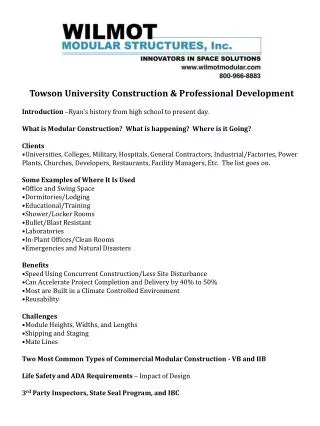
Towson University Construction & Professional Development • Introduction –Ryan’s history from high school to present day. • What is Modular Construction? What is happening? Where is it Going? • Clients • Universities, Colleges, Military, Hospitals, General Contractors, Industrial/Factories, Power Plants, Churches, Developers, Restaurants, Facility Managers, Etc. The list goes on. • Some Examples of Where It Is Used • Office and Swing Space • Dormitories/Lodging • Educational/Training • Shower/Locker Rooms • Bullet/Blast Resistant • Laboratories • In-Plant Offices/Clean Rooms • Emergencies and Natural Disasters • Benefits • Speed Using Concurrent Construction/Less Site Disturbance • Can Accelerate Project Completion and Delivery by 40% to 50% • Most are Built in a Climate Controlled Environment • Reusability • Challenges • Module Heights, Widths, and Lengths • Shipping and Staging • Mate Lines • Two Most Common Types of Commercial Modular Construction - VB and IIB • Life Safety and ADA Requirements – Impact of Design • 3rd Party Inspectors, State Seal Program, and IBC
Towson University Construction & Professional Development • How Are The Modules Constructed? • Perimeter and Outrigger Frames – 10” or 12” Beams – Impact to Foundations • Axles, Tires, & Hitches or Skid Mount • 7’8” to 15’8” Widths and Maximum 76’ Lengths – Site Concerns • Shipping Heights and Freight/Escorts/Costs - Impact of Design • Mate Lines – Impact of Design • Mechanical Systems – Wall-Mounted and Roof Top – Ductwork pre-installed • Electrical Systems – Pre-wired to individual panels in each module • Plumbing Fixtures – Pre-Installed and stubbed through floor • Cabinetry – Pre-Installed and set • Low Voltage Junction Boxes – Pre-Installed with conduit and pull strings • Interior Wall/Ceiling Finishes – Installed to meet project requirements • Windows/Doors – Installed per design and code requirements • Foundations • Geotechnical Soil Investigation – Industry Standard 3,000 psf conditions • 30” Finished Floor Heights with Crawlspace and Skirting • ABS Pads, 8” Hollow Block, Concrete Caps, and Wood Shims - Anchor • Augured Concrete Footings to Grade – Block to Steel Beams – Anchor • Stem Wall Foundations with Interior Piers • Decks/Steps/ADA Ramps/Canopies – Impact of Design • Examples of Projects • Tidewater Community College • Dominion Power • Washington Redskins • Edward Jones • Maryland Port Authority • U-Stor • Ft. Belvoir • Questions?