Naming and Drawing Organic Hydrocarbons Tutorial
Learn how to name and draw organic hydrocarbons, including alkanes and cycloalkanes. Understand the rules for naming structures with examples provided.

Naming and Drawing Organic Hydrocarbons Tutorial
E N D
Presentation Transcript
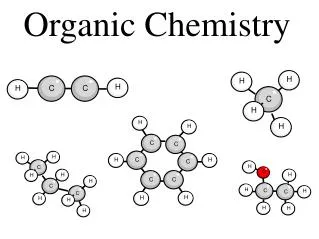
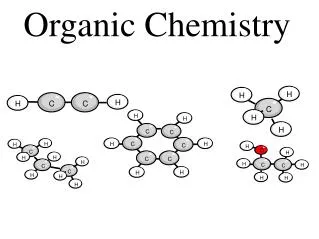
Organic Chemistry • Hydrocarbons contain carbon and hydrogen. • If all the bonds on the carbon atoms are single bonds, then the hydrocarbon is a Saturated Hydrocarbon. • Alkanesare saturated hydrocarbons. • They only contain single bonds.
Alkanes • Have the general formula CnH2n+2 (where n= the number of carbon atoms). • When naming them, the name ends in –ane. • All the carbons are bonded to 4 other atoms.
Example 1: Draw: 3-ethylheptane
Example 2: • Draw: 2,7-dimethylnonane
Example 3: • Draw: 4-ethyl-2,4,5-trimethyloctane
Example 4: 3,3,4,4-tetraethyl-2,2,5,5-tetramethylhexane
Cycloalkanes • All single bonds between the carbon atoms. • Have the general formula CnH2n • The ends of the carbon chain have bonded together to form a “ring” of carbons (lose 2 hydrogen atoms when this happens).
Examples: Draw: cyclobutane 1,3-dimethylcylcopentane 1-ethyl-3-methyl-2-propylcyclobutane
Rules for naming: 1) Find the parent chain (the longest continuous chain of carbon atoms); helpful to circle or put a box around the parent chain. 2) Number the carbon atoms on the parent chain so that the branches get the lowest combination of numbers; you can number it left to right or right to left. 3) Name the branches with –yl ending; if there are multiple of the same branch, use a prefix with the branch (di-, tri-, tetra-, penta-, hexa-, hepta-, octa-) 4) Put the branches with their # in alphabetical order. 5) The parent chain name goes at the end and ends in –ane.