Download
1 / 15
150 likes | 269 Vues
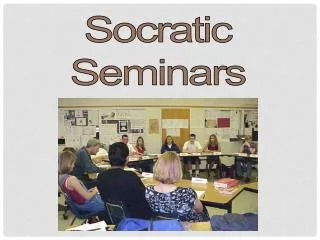
This introduction to Socratic Seminars emphasizes their role in cultivating critical survival skills for the 21st century. Participants will gain a deeper understanding of texts through curiosity, critical thinking, and communication. By identifying significant questions and engaging in thoughtful discussions, learners explore diverse perspectives, adapt to various roles, and use evidence to support their ideas. Preparation includes close reading of selected texts, posing higher-order questions, and self-assessment of performance, aligning with academic standards.

E N D
Socratic Seminars An Introduction
Purpose • To Build 21st Century Survival Skills • Achieve a deeper understanding about the ideas and values in a text
21st Century Survival Skills Critical Thinking and Problem Solving • Identifying and asking significant questions that clarify various points of view and lead to better solutions Curiosity and Imagination • Developing, implementing and communicating new ideas to others • Being open and responsive to new and diverse perspectives
21st Century Survival Skills Communication • Articulating thoughts and ideas clearly and effectively through speaking and writing Agility and Adaptability • Adapting to varied roles and responsibilities • Working effectively in a climate of ambiguity and changing priorities
21st Century Survival Skills Initiative and Entrepreneurialism • Going beyond basic mastery of skills and/or curriculum to explore and expand one’s own learning and opportunities to gain expertise Leadership and Collaboration • Using interpersonal and problem-solving skills to influence and guide others towards a goal • Acting responsibly with the interests of the larger community in mind
Good Discussion Good discussions occur when participants • Study the text closely in advance • Ask higher order thinking Qs • Listen attentively • Share their ideas and questions in response to the ideas and questions of others • Search for evidence in the text to support their ideas
Burden of Responsibility The participants carry the burden of responsibility for the quality of the discussion.
Preparation • Read text closely • The Kite Runner • A short informational text (should be read and annotated) • Connect the informational text to events in The Kite Runner • Pose higher order thinking Qs using Bloom’s Taxonomy • Identify 2 Qs to pursue during the discussion • Answer 2 Qs in paragraph form using textual evidence
Preparation Tool • Complete Questions for Socratic Seminar and bring to class on the day of the Socratic Seminar. • You will not be allowed to participate in the Socratic Seminar without completingQuestions for Socratic Seminar
During • I will be observing and recording.
Afterward • Participants will Self-Assess their preparation and performance during the Socratic Seminar. • I will collect your Questions for Socratic Seminar and your annotated article as a part of the evaluation. • As soon as possible I will give your feedback using the following rubric:
Standards • Socratic Seminars will be used to meet academic standards for: • Analyze themes/central ideas/events and their development throughout the text (F/IT) • Cite strong textual evidence to support analysis of text (F/IT) • Determine meanings of words/phrases in a text (e.g. figurative language, connotation, word choice, tone) (IT)
Dates • Socratic Seminars will be held: • Wednesday, 10/15 (Formative) • Friday, 10/24 (Formative) • Friday, 10/31 (Summative)