The Art of Rounding Numbers: Simplifying Communication and Calculation
Rounding numbers is an essential skill that enhances communication and makes numerical information easier to understand. Instead of focusing on precise values, rounding gives us a simplified version that is often more practical for everyday use. For instance, saying "about 17.6 kilometers" instead of "17.62955 kilometers" feels more conversational. This guide explores rounding techniques, such as rounding to the nearest tenth, and the rules for determining how to round a number accurately. Practice with examples to build your rounding skills!

The Art of Rounding Numbers: Simplifying Communication and Calculation
E N D
Presentation Transcript
Rounding Numbers ♦ Sometimes, we don’t need a number to be completely accurate. In fact, sometimes we prefer it to be rounded:
Rounding Numbers ♦ Sometimes, we don’t need a number to be completely accurate. In fact, sometimes we prefer it to be rounded: Ex) If you asked a friend how far it was to his house, how would you feel if he said,
Rounding Numbers ♦ Sometimes, we don’t need a number to be completely accurate. In fact, sometimes we prefer it to be rounded: Ex) If you asked a friend how far it was to his house, how would you feel if he said, “Oh, it’s about 17.62955 kilometres away.”
Rounding Numbers ♦ Sometimes, we don’t need a number to be completely accurate. In fact, sometimes we prefer it to be rounded: Ex) If you asked a friend how far it was to his house, how would you feel if he said, “Oh, it’s about 17.62955 kilometres away.” ♦ Rounding numbers makes communication easier!
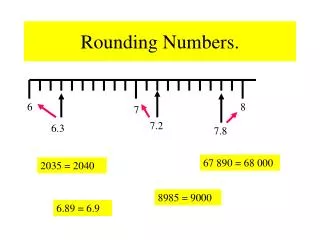
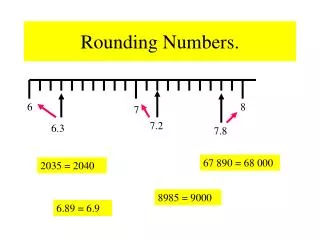
Rounding Numbers ♦ Ex) Round 16.8722 to the nearest tenth.
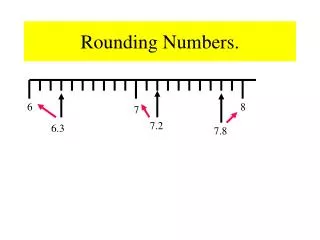
Rounding Numbers ♦ Ex) Round 16.8722 to the nearest tenth. Ask, “Is that number closer to 16.8 or 16.9 ?”
Rounding Numbers ♦ Ex) Round 16.8722 to the nearest tenth. Ask, “Is that number closer to 16.8 or 16.9 ?” How do you decide?
Rounding Numbers ♦ Ex) Round 16.8722 to the nearest tenth. Ask, “Is that number closer to 16.8 or 16.9 ?” How do you know? Check the “key” digit to the right of the tenths column.
Rounding Numbers ♦ Ex) Round 16.8722 to the nearest tenth. Ask, “Is that number closer to 16.8 or 16.9 ?” How do you decide? Check the “key” digit to the right of the tenths column. THINK: Is 87 closer to 80 or 90 ?
Rounding Numbers ♦ Ex) Round 16.8722 to the nearest tenth. Ask, “Is that number closer to 16.8 or 16.9 ?” How do you decide? Check the “key” digit to the right of the tenths column. THINK: Is 87 closer to 80 or 90 ? The number equals 16.9 rounded to the nearest tenth.
Rounding Numbers RULE:
Rounding Numbers RULE: Locate the position of the final digit. If the key digit is 5 or greater, then round the final digit up. Otherwise, the final digit stays the same.
Rounding Numbers ♦ Ex) Complete the following table:
Rounding Numbers ♦ Ex) Complete the following table:
Rounding Numbers ♦ Ex) Complete the following table:
Rounding Numbers ♦ Ex) Complete the following table:
Rounding Numbers ♦ Ex) Complete the following table:
Rounding Numbers ♦ Ex) Complete the following table:
Rounding Numbers ♦ Ex) Complete the following table: