SlideServe
Menu
Préférences
© SlideServe · v2026

Understanding Linking Verbs: Grammar Essentials for Students

jules avatar
7 diapositives · 349 Views · Jul 19, 2014

This educational guide breaks down the concept of linking verbs, essential for constructing meaningful sentences. It explains the definition, function, and examples of linking verbs, highlighting their role in connecting the subject with a predicate nominative or predicate adjective. Learn the differences between linking verbs and action verbs, explore various examples, and see how they integrate into sentence structure. Perfect for students aiming to strengthen their grammar knowledge and enhance their writing skills.
Understanding Linking Verbs: Grammar Essentials for Students - slide 1
01 / 7Understanding Linking Verbs: Grammar Essentials for Students
1 / 17

Télécharger la présentation

Understanding Linking Verbs: Grammar Essentials for Students
Une image / un lien ci-dessous est fourni (tel quel) pour télécharger la présentation

Politique de téléchargement : le contenu du site vous est fourni TEL QUEL pour votre information et votre usage personnel ; il ne peut être vendu, concédé sous licence ni partagé sur d’autres sites sans l’accord de son auteur.Le contenu vous est fourni TEL QUEL, pour votre information et votre usage personnel uniquement. Téléchargez la présentation en cliquant sur ce lien. Lors du téléchargement, si vous ne parvenez pas à télécharger une présentation, l’éditeur a peut-être supprimé le fichier de son serveur.Pendant le téléchargement, si vous ne parvenez pas à obtenir une présentation, le fichier a peut-être été supprimé par l’éditeur.

F I N

Plus de contenu associé

Transcription de la présentation
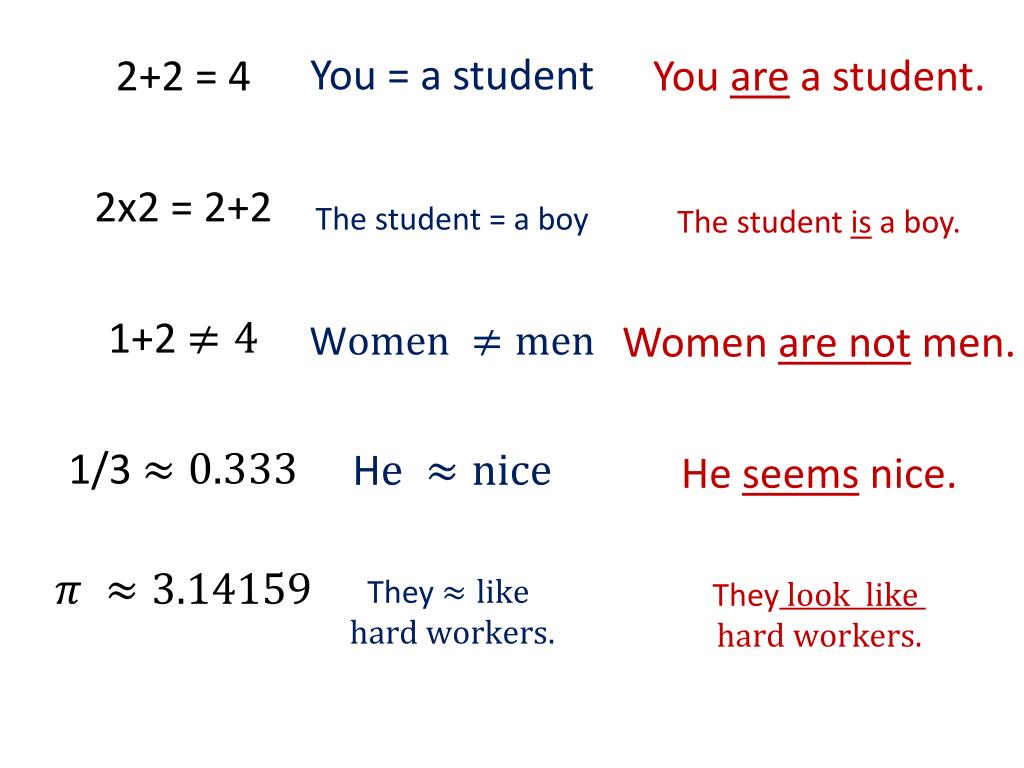
  1. You = a student The student = a boy W H They You are a student. The student is a boy. Women are not men. He seems nice. They 2+2 = 4 2x2 = 2+2 1+2 1/3

  2. Grammar Vocabulary (See Green Sheet) 28. Linking Verb: a verb that indicates a state of being, a verb that means = (equals) or “to be” verbs I am a teacher./I = a teacher. We are angry./We = angry. “to seem” & “to become” He seems nice./He nice. Boys become tall. Boys=tall. SOMETIMES LINKING: to appear, to remain, to stay, to prove, to grow, to get, to turn, to look, to smell, to sound, to taste, to feel

  3. Examples: He appears tired./He = tired. They remained here./They=here. She stays here./ She = here. The day proved hot./The day = hot. He grows angry./He = angry. They get sad./They = sad. He turned against me./ He = against me. It looks bad./ It = bad. It smells rotten./It = rotten. It sounds horrible./It = horrible. It tastes delicious./It = delicious. It feels rough./ It = rough.

  4. Examples of when they are NOT linking verbs: The rainbow appeared in the sky. He proves his point. I grew a garden. She gets a hotdog for lunch. He turns the car right. I look at you. I smelled a nasty smell. He tastes the pizza.

  5. 29. The words after a linking verb are predicate nominatives (nouns/pronouns/noun clauses) • It is a dog. • He is a man. • They are soccer players. • It is she. • This is he. • It is mine. • The car is hers. • It is what I like.

  6. -OR- 30. predicate adjectives • (adjectives, adjective phrases). • They are beautiful. • It is tasty. • The food is exotic. • It is under the desk. • My car is in the garage. • My mother is at home. • My test is on Friday.

  7. Name_____________________ Date________ Making Sentences with Transitive Verbs and Linking Verbs • S-TV-IO-DO. Example: My teacher gives me a food. 2. S-LV-Adj. (Prep. Phrase of Location). Example: The food is in a bag. • S-LV-Adj. (size). Example: It looks small. • S-LV-Adj. (shape). Example: It is square. • S-LV-Adj. (texture). Example: It feels smooth. • S-TV-DO. Example: I taste the food. • S-LV-Adj. (taste). Example: It tastes delicious. • S-LV-N. Example: It is a dark chocolate candy.