Understanding Cloud Computing: History, Characteristics, and Service Models
This presentation by Jeremy Olson provides a comprehensive overview of cloud computing, discussing its definition, historical context, and essential characteristics such as on-demand self-service and resource pooling. It explores various service models including Software as a Service (SaaS), Platform as a Service (PaaS), and Infrastructure as a Service (IaaS). Additionally, it examines deployment models like private, public, and hybrid clouds, and highlights commonly used services such as Google Chrome OS, Dropbox, and Amazon Web Services. A valuable roadmap for understanding the cloud landscape.

Understanding Cloud Computing: History, Characteristics, and Service Models
E N D
Presentation Transcript
Cloud ComputinG Presented by Jeremy Olson CPE 401 Spring 2011
Roadmap • What is cloud computing? • Short history • Essential characteristics • Service models • Deployment models • Commonly used services today
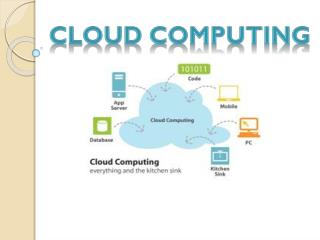
What is cloud computing? Basically a paradigm to describe accessing applications and data using an internet browser, instead of installing and running programs on PC’s.
Brief history • “Cloud” – symbol representing underlying infrastructure of the Internet • “Computing as a public utility” – John McCarthy • The Challenge of the Computer Utility, Douglas Parkhill
Essential Characteristics • On-demand self-service • Broad network access • Resource pooling • Rapid elasticity • Measured service
Service models • Cloud Software as a Service (SaaS) • Cloud Platform as a Service (PaaS) • Cloud Infrastructure as a Service (IaaS)
Deployment models • Private cloud • Community cloud • Public cloud • Hybrid cloud
Commonly used cloud services • Google Chrome OS • Dropbox • Amazon Web Services • Windows Azure
Resources • http://www.nist.gov/itl/cloud/upload/cloud-def-v15.pdf • http://www.nist.gov/itl/cloud/ • http://www.cloudcomputingdefined.com/ • http://mirror.switch.ch/ftp/doc/ietf/ipatm/atm-minutes-93jul.txt • http://www.microsoft.com/windowsazure/ • http://aws.amazon.com/ • http://www.microsoft.com/en-us/cloud/default.aspx?fbid=_VZsfsMr0u5 • http://www.google.com/chromeos/features.html • http://www.drbackup.com.au/images/Cloud_Diagram.gif?390