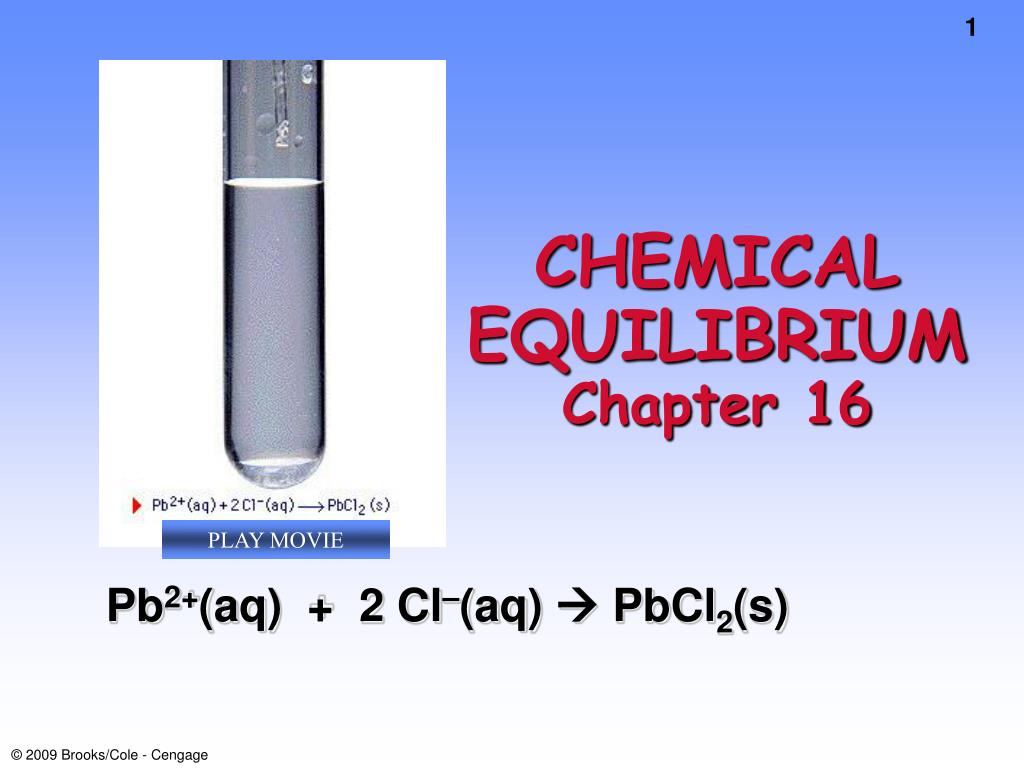
This chapter delves into the principles of chemical equilibrium, highlighting its dynamic and reversible nature. Key concepts include the establishment of equilibrium between reactants and products, as well as the significance of the equilibrium constant (K). Various examples illustrate equilibrium in action, such as phase changes and solubility reactions. The behavior of reaction quotients (Q) in relation to K is discussed, providing insight into whether reactions favor products or reactants. This foundational knowledge is crucial for understanding chemical reactions in various contexts.
Une image / un lien ci-dessous est fourni (tel quel) pour télécharger la présentation
Politique de téléchargement : le contenu du site vous est fourni TEL QUEL pour votre information et votre usage personnel ; il ne peut être vendu, concédé sous licence ni partagé sur d’autres sites sans l’accord de son auteur.Le contenu vous est fourni TEL QUEL, pour votre information et votre usage personnel uniquement.Téléchargez la présentation en cliquant sur ce lien.Lors du téléchargement, si vous ne parvenez pas à télécharger une présentation, l’éditeur a peut-être supprimé le fichier de son serveur.Pendant le téléchargement, si vous ne parvenez pas à obtenir une présentation, le fichier a peut-être été supprimé par l’éditeur.
Properties of an Equilibrium Equilibrium systems are • DYNAMIC (in constant motion) • REVERSIBLE • can be approached from either direction PLAY MOVIE Pink to blue Co(H2O)6Cl2 Co(H2O)4Cl2 + 2 H2O Blue to pink Co(H2O)4Cl2 + 2 H2O Co(H2O)6Cl2
Chemical EquilibriumFe3+ + SCN-e FeSCN2+ • After a period of time, the concentrations of reactants and products are constant. • The forward and reverse reactions continue after equilibrium is attained. PLAY MOVIE PLAY MOVIE
Examples of Chemical Equilibria Formation of stalactites and stalagmites CaCO3(s) + H2O(liq) + CO2(g)Ca2+(aq) + 2 HCO3-(aq)
Chemical Equilibria CaCO3(s) + H2O(liq) + CO2(g) Ca2+(aq) + 2 HCO3-(aq) At a given T and P of CO2, [Ca2+] and [HCO3-] can be found from the EQUILIBRIUM CONSTANT.
Equilibrium achieved See Active Figure 16.2 Reaction Quotient & Equilibrium Constant Product conc. increases and then becomes constant at equilibrium Reactant conc. declines and then becomes constant at equilibrium
Equilibrium achieved Reaction Quotient & Equilibrium Constant In the equilibrium region
The Reaction Quotient, Q In general, ALL reacting chemical systems are characterized by their REACTION QUOTIENT, Q. a A + b B c C + d D If Q = K, then system is at equilibrium.
THE EQUILIBRIUM CONSTANT For any type of chemical equilibrium of the type a A + b B c C + d D the following is a CONSTANT (at a given T) If K is known, then we can predict concs. of products or reactants.
Determining K 2 NOCl(g) 2 NO(g) + Cl2(g) Place 2.00 mol of NOCl is a 1.00 L flask. At equilibrium you find 0.66 mol/L of NO. Calculate K. Solution Set of an “ICE” table of concentrations [NOCl] [NO] [Cl2] Initial 2.00 0 0 Change Equilibrium 0.66
Determining K 2 NOCl(g) 2 NO(g) + Cl2(g) Place 2.00 mol of NOCl is a 1.00 L flask. At equilibrium you find 0.66 mol/L of NO. Calculate K. Solution Set of an “ICE” table of concentrations [NOCl] [NO] [Cl2] Initial 2.00 0 0 Change -0.66 +0.66 +0.33 Equilibrium 1.34 0.66 0.33
The Meaning of K 1. Can tell if a reaction is product-favored or reactant-favored. For N2(g) + 3 H2(g) 2 NH3(g) Conc. of products is much greater than that of reactants at equilibrium. The reaction is strongly product-favored.
The Meaning of K For AgCl(s) Ag+(aq) + Cl-(aq) Kc = [Ag+] [Cl-] = 1.8 x 10⁻⁵ Conc. of products is much less than that of reactants at equilibrium. The reaction with small K is strongly reactant-favored. Ag+(aq) + Cl-(aq) e AgCl(s) is product-favored.
The Meaning of K K comes from thermodynamics. (See Chapter 19) ∆G˚ < 0: reaction is product favored ∆G˚ > 0: reaction is reactant-favored If K > 1, then ∆G˚ is negative If K < 1, then ∆G˚ is positive
The Meaning of K 2. Can tell if a reaction is at equilibrium. If not, which way it moves to approach equilibrium. PLAY MOVIE PLAY MOVIE
The Meaning of K If [iso] = 0.35 M and [n] = 0.15 M, are you at equilibrium? If not, which way does the reaction “shift” to approach equilibrium? See Chemistry Now
The Meaning of K All reacting chemical systems are characterized by their REACTION QUOTIENT, Q. If Q = K, then system is at equilibrium. Q (2.33) < K (2.5) Reaction is NOT at equilibrium, so [iso] must become ________ and [n] must ____________.
Æ Typical Calculations PROBLEM: Place 1.00 mol each of H2 and I2 in a 1.00 L flask. Calc. equilibrium concentrations. H2(g) + I2(g) 2 HI(g)
H2(g) + I2(g) 2 HI(g)Kc = 55.3 Step 1. Set up ICE table to define EQUILIBRIUM concentrations. [H2] [I2] [HI] Initial 1.00 1.00 0 Change Equilib
H2(g) + I2(g) 2 HI(g)Kc = 55.3 Step 1. Set up ICE table to define EQUILIBRIUM concentrations. [H2] [I2] [HI] Initial 1.00 1.00 0 Change -x -x +2x Equilib 1.00-x 1.00-x 2x where x is defined as am’t of H2 and I2 consumed on approaching equilibrium.
Nitrogen Dioxide EquilibriumN2O4(g) 2 NO2(g) If initial concentration of N2O4 is 0.50 M, what are the equilibrium concentrations? Step 1. Set up an ICE table [N2O4] [NO2] Initial 0.50 0 Change Equilib
Nitrogen Dioxide EquilibriumN2O4(g) 2 NO2(g) If initial concentration of N2O4 is 0.50 M, what are the equilibrium concentrations? Step 1. Set up an ICE table [N2O4] [NO2] Initial 0.50 0 Change -x +2x Equilib 0.50 - x 2x
Nitrogen Dioxide EquilibriumN2O4(g) 2 NO2(g) Step 2. Substitute into Kc expression and solve. Rearrange: 0.0059 (0.50 - x) = 4x2 0.0029 - 0.0059x = 4x2 4x2 + 0.0059x - 0.0029 = 0 This is a QUADRATIC EQUATION ax2 + bx + c = 0 a = 4 b = 0.0059c = -0.0029
Nitrogen Dioxide EquilibriumN2O4(g) 2 NO2(g) x = 0.026 or -0.028 But a negative value is not reasonable. Conclusion: x = 0.026 M [N2O4] = 0.050 - x = 0.47 M [NO2] = 2x = 0.052 M x = -0.00074 ± 1/8(0.046)1/2 = -0.00074 ± 0.027
Solving Quadratic Equations • Recommend you solve the equation exactly on a calculator or use the “method of successive approximations” • See Appendix A.
Writing and Manipulating K Expressions Adding equations for reactions S(s) + O2(g) SO2(g) SO2(g) + 1/2 O2(g) SO3(g) Net equation S(s) + 3/2 O2(g) SO3(g)
Writing and Manipulating K Expressions Concentration Units We have been writing K in terms of mol/L. These are designated by Kc But with gases, P = (n/V)·RT = conc · RT P is proportional to concentration, so we can write K in terms of P. These are designated by Kp. Kc and Kp may or may not be the same.
Writing and Manipulating K Expressions K using concentration and pressure units Kp = Kc(RT)∆n For S(s) + O2(g) SO2(g) ∆n = 0 and Kp = Kc For SO2(g) + 1/2 O2(g) SO3(g) ∆n = –1/2 and Kp = Kc(RT)–1/2
EQUILIBRIUM AND EXTERNAL EFFECTS • Temperature, catalysts, and changes in concentration affect equilibria. • The outcome is governed by LE CHATELIER’S PRINCIPLE • “...if a system at equilibrium is disturbed, the system tends to shift its equilibrium position to counter the effect of the disturbance.”
EQUILIBRIUM AND EXTERNAL EFFECTS • Temperature change change in K • Consider the fizz in a soft drink CO2(aq) + HEATCO2(g) + H2O(liq) • K = P (CO2) / [CO2] • Increase T. What happens to equilibrium position? To value of K? • K increases as T goes up because P(CO2) increases and [CO2] decreases. • Decrease T. Now what? • Equilibrium shifts left and K decreases.
Temperature Effects on Equilibrium N2O4 (colorless) + heat 2 NO2 (brown) ∆Ho = + 57.2 kJ Kc (273 K) = 0.00077 Kc (298 K) = 0.0059 PLAY MOVIE
EQUILIBRIUM AND EXTERNAL EFFECTS • Add catalyst no change in K • A catalyst only affects the RATE of approach to equilibrium. Catalytic exhaust system