
The International System of Units (SI)
E N D
Presentation Transcript
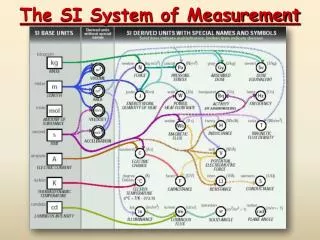
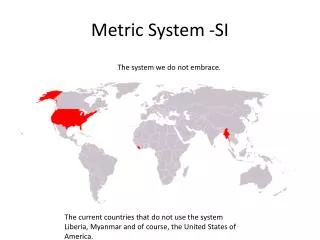
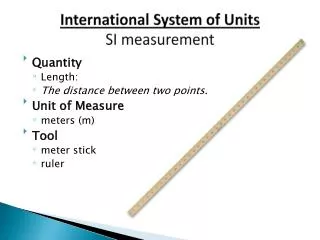
The International System of Units (SI) • The International System of Units (SI) is a system of units of measurement consisting of seven base units • Mostly widely used system of measurement • United States is the only industrialized nation that has not adopted the SI system
The International System of Units • Often referred to as the metric scale • Prefixes indicate an integral power of 10
Common Items: Size Comparison U S Customary System S I
Recording Measurements • Measurements must always include units • Always errors in measurements • measurements are the best “estimate” of a quantity • A measurement is only good if you know that it is reasonable close to the actual quantity • It is important to indicate the accuracy and precision of your measurements • Scientists and engineers use significant digits to make the accuracy and precision of measurements clear
Precision and Accuracy • Precision (repeatability) = the degree to which repeated measurements show the same result • Accuracy = the degree of closeness of measurements of a quantity to the actual (or accepted) value High Accuracy Low Precision High Precision Low Accuracy High Accuracy High Precision
Recording Measurements • Ideally, a measurement device is both accurate and precise • Accuracy depends on calibration to a standard • Precision depends on the characteristics and/or capabilities of the measuring device and its use • Use significant digits to indicate the accuracy and precision of experimental results • Record only to the precision to which you and your measuring device can measure
Significant Digits • Accepted practice in science is to indicate accuracy and/or precision of measurement • Significant digits are digits in a decimal number that carry meaning contributing to the precision or accuracy of the quantity • The digits you record for a measurement are considered significant • Include all certain digits in a measurement and one uncertain digit • Note: fractions are “fuzzy” numbers in which significant digits are not directly indicated
Recording Measurements • Manufacturers of equipment usually indicate the accuracy and precision of the instrument • General Rules • Digital Instruments – read and record all the numbers, including zeros after the decimal point, exactly as displayed • Decimal Scaled Instruments – record all digits that you can certainly determine from the scale markings and estimate one more digit • Preferred over fractional scaled instruments • Fractional Scaled Instruments – need special consideration
Metric Scale • A typical metric scale often includes a30+ centimeter graduated scale • Each centimeter is graduated into 10 millimeters
The Millimeter • The millimeter is the smallest increment found on a typical SI scale 1 mm
The Millimeter • The next larger marking on a SI scale shows 5 millimeters 5 mm
The Millimeter • Largest markings on a SI scale represents centimeters (cm) • These are the only marks that are actually numbered. 1 cm = 10 mm
Measurement: Using a Decimal Scale • How long is the rectangle? • Let’s look a little closer
Measurement: Using a Decimal Scale • How long is the rectangle?
Recording a Measurement • How long is the rectangle? • Remember the General Rule • Decimal Scaled Instruments – record all digits that you can certainly determine from the scale markings and estimate one more digit Best Estimate = 3.84 cm
Recording a Measurement • How long is the rectangle? • Remember the General Rule • Decimal Scaled Instruments – record all digits that you can certainly determine from the scale markings and estimate one more digit Best Estimate = 3.84 cm Certain
Your Turn • How would you record the length of this rectangle? • How many significant digits? 6.33 cm 3
Your Turn Record each measurement in centimeters using the appropriate number of significant digits.