Understanding Price Elasticity of Demand and Supply: Key Concepts and Calculations
This comprehensive overview covers the fundamentals of price elasticity of demand and supply, including how quantity demanded or supplied changes in response to price fluctuations. Explore the determinants of price elasticity, the difference between necessities and non-necessities, and the availability of close substitutes. Learn how to calculate elasticity using real-world examples, interpret the results, and understand their implications on revenue. This guide is essential for anyone studying economics or looking to grasp the intricacies of market behavior.

Understanding Price Elasticity of Demand and Supply: Key Concepts and Calculations
E N D
Presentation Transcript
ELASTICITY How quantity demanded or supplied changes with changes in price
Determinants of Price Elasticity of Demand Necessities versus Non-necessities Availability of Close Substitutes Definition of the Market Time Horizon
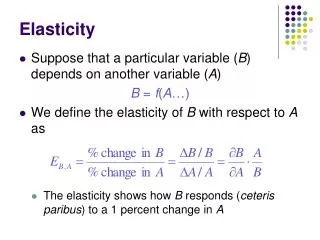
How to calculate the Price Elasticity of Demand i = initial and f = final
Example If the price of a unit of the good increases from $4 to $5 and the amount you buy falls from 100 to 50 units/week then your elasticity of demand would be calculated as:
How to Interpret Elasticity A price elasticity of –2 means that: if price increases by 1%, quantity demanded decreases by 2%.
$5 A 25% increase in price... Demand 75 ...leads to a 25% decrease in quantity demanded. Unit Elastic Demand: Elasticity equals -1 Ed = %dQ %dP -.25 .25 = -1 Price $4 Quantity 100
Elastic Demand: Elasticity is greater than –1 $5 A 25% increase in price... Demand 50 ...leads to a 50% decrease in quantity demanded. Ed = %dQ %dP = -.50 .25 = -2 Price 价格 $4 Quantity 100
$5 A 25% increase in price... $4 Demand 90 ...leads to a 10% decrease in quantity demanded. Inelastic Demand: Elasticity is less than –1 Ed = %dQ %dP -.10 .25 = -.4 Price Quantity 100
Elasticity and Total Revenue: Inelastic demand $5 A 25% increase in price... $4 Demand 90 100 ...leads to a 10% decrease in quantity demanded. P Revenue increases Price Revenue = $450 Revenue = $400 Quantity
Elasticity and Total Revenue: Elastic demand $5 A 25% increase in price... $4 Demand 50 100 ...leads to a 50% decrease in quantity demanded. P Revenue decreases Price价格 Revenue = $250 Revenue = $400 Quantity
Crude Oil Prices Nominal$Inflation-adjusted 2011 US$ $/barrel
Supply: Crude Oil Production 000s barrels/day
Estimating Demand Elasticity for Oil 1979-80 Year 1979 1980 Price $/barrel $20 $30 Quantity Barrels/day (millions) 64 56
Effect of Decrease in Supply in Oil Market with Inelastic Demand When demand is inelastic, a decrease in supply... $/barrel S2 S1 leads to a large increase in price (50%) 30 Revenue= $1680 20 Revenue= $1280 Demand Barrels/day (millions) 0 56 64 and a proportionately smaller decrease (12.5%) in quantity sold.
Effect of Decrease in Supply in Oil Market with Elastic Demand $/barrel When demand is elastic, a decrease in supply... S2 S1 leads to a small increase in price (10%) 22 Revenue = $1100 20 Revenue = $1280 Demand Barrels/day (millions) 0 50 64 and a proportionately larger decrease (22%) in quantity sold.
Effect of Increase in Supply in Wheat Market with Inelastic Demand When demand is inelastic,an increase in supply... $/bushel S1 S2 leads to a large decrease in price (50%) 3 Revenue= $900 2 Revenue = $660 Demand 0 300 330 Bushels per day (millions) and a proportionately smaller increase (10%) in quantity sold.
Supply $5 A 25% increase in price... 4 100 200 ...leads to a 100% increase in quantity supplied. Elastic SupplyElasticity is greater than 1 Price Es = %dQ %dP = 1.00 .25 = 4 Quantity
Supply $5 A 25% increase in price... 4 100 110 ...leads to a 10% increase in quantity supplied. Inelastic SupplyElasticity is less than 1 Price Es = %dQ %dP = .10 .25 = 0.4 Quantity