

SlideServe
Menu
Préférences
© SlideServe · v2026

Percent Composition

kaden-bradshaw avatar
8 diapositives · 385 Views · Nov 14, 2014

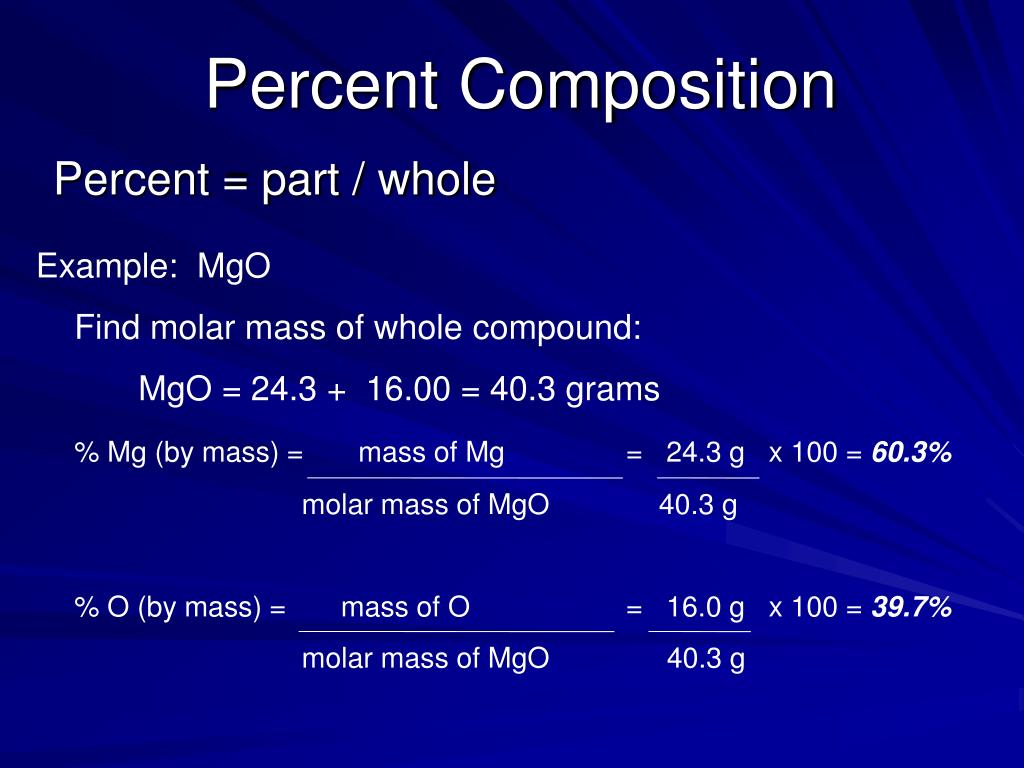
Percent Composition. Example: MgO Find molar mass of whole compound: MgO = 24.3 + 16.00 = 40.3 grams % Mg (by mass) = mass of Mg = 24.3 g x 100 = 60.3% molar mass of MgO 40.3 g
Percent Composition - slide 1
01 / 8Percent Composition
1 / 17

Télécharger la présentation

Percent Composition
Une image / un lien ci-dessous est fourni (tel quel) pour télécharger la présentation

Politique de téléchargement : le contenu du site vous est fourni TEL QUEL pour votre information et votre usage personnel ; il ne peut être vendu, concédé sous licence ni partagé sur d’autres sites sans l’accord de son auteur.Le contenu vous est fourni TEL QUEL, pour votre information et votre usage personnel uniquement. Téléchargez la présentation en cliquant sur ce lien. Lors du téléchargement, si vous ne parvenez pas à télécharger une présentation, l’éditeur a peut-être supprimé le fichier de son serveur.Pendant le téléchargement, si vous ne parvenez pas à obtenir une présentation, le fichier a peut-être été supprimé par l’éditeur.

F I N

Plus de contenu associé

Transcription de la présentation
  1. Percent Composition Example: MgO Find molar mass of whole compound: MgO = 24.3 + 16.00 = 40.3 grams % Mg (by mass) = mass of Mg = 24.3 g x 100 = 60.3% molar mass of MgO 40.3 g % O (by mass) = mass of O = 16.0 g x 100 = 39.7% molar mass of MgO 40.3 g Percent = part / whole

  2. Empirical Formulas • 4Steps: • Change the percent to grams • Convert grams to moles • Divide each of the moles by the smallest number to find the ratio • Round ratio to a whole number. If the ratio is not a whole number (ex. 1.5) multiply each element by 2 to get a whole number Gives the lowest whole-number ratio of elements and compounds in a formula

  3. Examples A compound contains 94.1% Oxygen and 5.9% Hydrogen. What is its empirical formula? • 94.1% = 94.1g O • 5.9% = 5.9g H 5.9g H 1 mol H 1 mol O • 94.1g O = 5.9 mol H = 5.88 mol O 16 g O 1 g H 5.9 5.88 • 5.88 • 5.88 = 1.003 (can round to 1.0) = 1.0 4) Ratio = 1:1 Formula = OH

  4. Examples A compound contains 67.6% Mercury and 10.8% Sulfur and 21.6% Oxygen. What is its empirical formula? • 67.6% = 67.6g Hg • 10.8% = 10.8g S • 21.6% = 21.6g O 67.6g Hg = 0.336 mol Hg 10.8g S = 0.338 mol S 21.6g O = 1.35 mol O • 0.336 • 0.336 0.338 0.336 1.35 0.336 = 1.00 Hg = 1.00 S = 4.02 O 4)Ratio = 1:1:4 Formula = HgSO4

  5. Examples What is the empirical formula for a compound containing 70.0% Fe and 30.0% O? • 70.0% = 70.0g Fe • 30.0% = 30.0g O 70.0g Fe = 1.25 mol Fe 30.0g O = 1.875 mol O 1.875 1.25 • 1.25 • 1.25 = 1.5 O = 1.00 Fe 4) Ratio = 1 : 1.5 5) Mult ratio by 2 = 2 : 3 Formula = Fe2O3

  6. Molecular Formulas • Same as empirical formula, or a simple whole-number multiple of it • Steps: • Calculate the mass in grams of the empirical formula provided • Divide the molar mass by the mass of the empirical formula • Multiply this whole number ratio by the empirical formula

  7. Examples Calculate the molecular formula of the compound whose molar mass is 60.0g and empirical formula is CH4N. 1) CH4N = 12 + 4(1) + 14 = 30.0 g • 60.0g • 30.0g = 2.0 3) 2.0 (CH4N) = C2H8N2

  8. Examples What is the molecular formula of ethylene glycol (CH3O), used in antifreeze. It has a molar mass of 62 g/mol. 1) CH3O = 31.0 g 3) 2.0 (CH3O) = C2H6O2 • 62.0g • 31.0g = 2.0 Find the molecular formula of C3H2Cl, which is mothballs. Its molar mass is 147 g/mol. 1) C3H2Cl = 73.0 g 3) 2.0 (C3H2Cl) = C6H4Cl2 • 147.0g • 73.0g = 2.0