Modeling Multiphase Fluids Trapped in Carbon Nanotubes
10 likes | 151 Vues
This study presents a comprehensive model for understanding the behavior of water volumes encapsulated within carbon nanotubes (CNTs). It combines theoretical and experimental approaches to analyze the evolution of these fluids under electron microscope observation, developing a quantitative framework that accounts for heat transfer and mass diffusion, including intermolecular interactions. The findings reveal strong agreement between model predictions and experimental data, confirming the proposed thermal mechanisms and offering insights into nanofluidic applications. Future work aims to extend these preliminary calculations further.


Modeling Multiphase Fluids Trapped in Carbon Nanotubes
E N D
Presentation Transcript
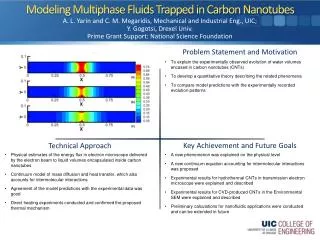
Modeling Multiphase Fluids Trapped in Carbon Nanotubes A. L. Yarinand C. M. Megaridis, Mechanical and Industrial Eng., UIC; Y. Gogotsi, Drexel Univ. Prime Grant Support: National Science Foundation • To explain the experimentally observed evolution of water volumes encased in carbon nanotubes (CNTs) • To develop a quantitative theory describing the related phenomena • To compare model predictions with the experimentally recorded evolution patterns • Physical estimates of the energy flux in electron microscope delivered by the electron beam to liquid volumes encapsulated inside carbon nanotubes • Continuum model of mass diffusion and heat transfer, which also accounts for intermolecular interactions • Agreement of the model predictions with the experimental data was good • Direct heating experiments conducted and confirmed the proposed thermal mechanism • A new phenomenon was explained on the physical level • A new continuum equation accounting for intermolecular interactions was proposed • Experimental results for hydrothermal CNTs in transmission electron microscope were explained and described • Experimental results for CVD-produced CNTs in the Environmental SEM were explained and described • Preliminary calculations for nanofluidic applications were conducted and can be extended in future