Updates on CDF Operations and Physics Results (October 2006)
400 likes | 515 Vues
This document outlines the status of the CDF collaboration led by Robert Roser and Jaco Konigsberg as of October 20, 2006. It includes details on detector and offline operations, high luminosity running, and resource management. Highlights feature successful data deliveries and operational improvements, such as enhanced computing capabilities. The presentation also discusses recent physics results, including measurements of the top quark mass, B_s mixing, and Higgs particle studies. A total of 50 publications are noted, emphasizing the collaboration's ongoing research efforts.


Updates on CDF Operations and Physics Results (October 2006)
E N D
Presentation Transcript
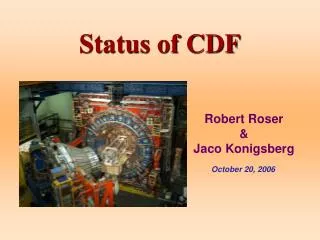
Status of CDF Robert Roser & Jaco Konigsberg October 20, 2006
Outline • Detector Operations • Offline Operations • High Luminosity Running • Physicist Resources • Streamlining • Physics • B_s • Top Quark Mass • Higgs • Conclusions
Publications * Submitted+Accepted+Published thus far • We currently have ~50 papers under internal review
Detector Operations at a Glance • 653 pb-1 delivered in FY06, 82% to tape • ~5% trigger deadtime, ~5% beam conditions, ~5% problems 2.0 fb-1 delivered 1.6 fb-1 to tape
Silicon Aging Like Fine (California) Wine Innermost layer of SVX 92% 85% ● powered ● <1% error Silicon should operate well for the duration of Run II
COT Gain vs. Time Inner layer Outer layer Jan.2002 Aug.2005 Central Outer Tracker • COT enjoying a breath of fresh air…
Offline Operations • Computing will always require attention. • Dealing with continually larger data sets and faster acquisition of data, and evolving technology • Highlights of this years Successes include • Reduced operational load • Enhance GRID computing capabilities • Maintained 6 week turn around for data this past year • Standard Ntuples now made in an automated fashion • MC production done off-site, code sped up 30-50% • We are moving toward an incremental model • “once and done!”
Preparations for High Luminosity • dE/dX turned off on COT for inner layers • No significant loss in particle ID expected • XFT Trigger Upgrade • Level 1 commissioning complete • 97% efficiency, exceeded expectationsmet fake rejection specs (3-5x) • Level 2 commissioning in progress • Matching in 3D to other objects, finer resolution • DAQ – building a bigger pipe! • event builder upgrade COMPLETE – achieved >900hz at 200e30 (was 200 hz) • CSL – bandwidth increased from 20→80 Mb/sec
XFT upgrade project • XFT originally only utilized axial layers • Upgrade adds 3 stereo layers to 4 layer axial XFT system • better fake rejection • better resolution
fake reduction fakes with old system fakes with new system factor 7-8 reduction! Phi
Triggering at High Luminosity • Run at 2.3e32 thus far • identified 5 triggers out of 150 that are misbehaving • We have a plan for dealing with each one • XFT upgrade • Configuring additional Level 2 CDF electronics to build a new calorimeter cluster finder • Don’t see any significant obstacles to developing a trigger table for 3e32 for discovery datasets
CDF Collaboration • 620 people from 61 institutions and 13 countries FranceLPNHE,Paris
Addressing our Staffing Needs • We are taking the following steps • Maintaining our current resources • Understanding our needs • Aggressively recruiting new resources • Streamlining Operations
Understanding our Needs Doing it for all subsystems & ops tasks
Maintaining our Current Resources • Keeping the experiment vital • Making data analysis accessible • Staying in constant touch with our collaboration • Asking senior people to take leadership roles
Acquiring New Resources • New Fermilab International Fellowships to bring in a post doc and an experienced senior person • Working with funding agencies and universities to obtain supplemental monies where they can be most productive • Use guest/visitors funds to fill critical needs • Three new Groups interested in participating on CDF • New Institutions: Slovakia • Visitors: Greece, Mexico
Ph.D. Students Poll • Each institution sent: • # of Ph.D. students to join CDF [for thesis] • 45 responded (23 US & 22 non-US) Counting from ~1yr ago we have 90 new students ! ~ 2 yrs ago ~ 1 yr ago recently
Streamlining – The Point! • Capturing Knowledge • Getting to high quality data faster • Freeing up resources for other tasks
Doing more with Less • Detector Operations • Reducing shift crew by one person • Reassigning tasks within crew • Increased automation • Improved training • Remote Control Room in Italy • Replace one crew member on “local” owl shift • Offline • Automating detector calibrations • Single point submission for MC • Extensive automation of production farms • Physics • Automating various particle ID and trigger efficiencies • Automating MC and data validation • Automating b-tag efficiency and fake rates • Automating Jet Energy Scale
ICHEP - Moscow • 31 new 1 fb-1 results presented • Final conference summary talk covered our top mass, B_s mixing, and higgs results. • Higgs combo • diphoton • ZZ • HT emu • Z pt spectrum • triphoton • diphoton+met • l+gamma+X • ttbar+gamma • monojet • Bs mixing: semi-lept • Bs mixing: hadr • Bc->J/Psi pi • Lb lifetime • Chic x-sections • Orb. exc. B_s • etab->J/PsiJ/Psi • incl. Jet kt • incl. Jet cone • Kt distributions of particles in jets • mtop l+jets • mtop dilepton • mtop hadronic • top x-sec hadronic • W helicity I, II • WH->lvbb • ZH->llbb • ZH->vvbb • -
2006 Physics Highlights to Date • B_s Mixing • Observation (9/25/06) • http://www.fnal.gov/pub/presspass/press_releases/CDF_meson.html • 3 Sigma Evidence (4/11/06) • http://www.fnal.gov/pub/presspass/press_releases/CDF_04-11-06.html • First observation of B baryon Σb • Press release in progress • Worlds single best top mass measurement • New Higgs Limits
Bs Oscillation: CDF 1 fb-1 April 2006 • Evidence: • 0.2% probability (> 3) random fluctuation would look like a signal • ms = 17.31 +0.33-0.18 ± 0.07 ps-1 • |Vtd / Vts| = 0.208 +0.001-0.002 (expt.) +0.008-0.006 (theo.) Lab Press Release on April 11: Fermilab CDF scientists present a precision measurement of a subtle dance between matter and antimatter. PRL 97, 062003 (2006) hep-ex/0606027
Bs Oscillation: CDF 1 fb-1 Sept 2006 • Observation: • 8 x 10⁻⁸ probability (> 5) random fluctuation would look like a signal • Effective statistics a factor of 2.5: Evidence became Observation. Lab Press Release on September 25: IT MIGHT BE… IT COULD BE… IT IS!!! Fermilab's CDF scientists make it official: They have discovered the quick-change behavior of the B-sub-s meson, which switches between matter and antimatter 3 trillion times a second. hep-ex/0609040
Bs Oscillation: CDF 1 fb-1 Sept 2006 • Observation: • 8 x 10⁻⁸ probability (> 5) random fluctuation would look like a signal • Effective statistics a factor of 2.5: Evidence became Observation. • ms = 17.77 ± 0.10 ± 0.07 ps-1 • |Vtd / Vts| = 0.2060 ± 0.0007 (expt.) ± 0.0081 (theo.) hep-ex/0609040
Top Quark Mass • Excellent results in each channel • Mtop (Combined)= 170.9 ± 2.4 GeV Mtop (stat.) = ± 1.4 GeV Mtop (syst.) = ± 1.9 GeV • Mtop determined to 1.4% • With < 1 fb-1, we have surpassed Run IIa (2 fb-1) Goal!
Postscript • Data makes us smarter… • B_s observation was made with the identical data set we used in the “evidence” analysis • Made use of more advanced analysis techniques including neural networks to separate signal from background… • Used more difficult partial decay modes to effectively expand our dataset • Top Mass is already better than our 2 fb-1 goal • A lot of work on jet energy scale • Better understanding of radiation • More sophisticated analysis techniques
The Future of Top • CDF Measurements will continue to improve
The Neighborhood for Higgs mW (GeV) Indicates Higgs is light (Mh < 166 GeV at 95% CL) Where Tevatron sensitivity is best! mtopTevatron = 171.4 ± 2.1 GeV!≈√ mtop (GeV)
Search for Higgs… • Tevatron is already within a factor of 3 in terms of sensitivity for SM Higgs at certain MH • We are continuing to develop the tools needed to optimize this measurement • We are optimizing our high luminosity trigger table for Higgs ~15 CDF + DØ Results combined. SM Sensitivity within a factor of 5-10 for 110 < Mhiggs < 200 GeV
Tracking Improvements • Still improving the performance of our tracking algorithms • Here we are making use of information in the “forward” direction to extend our tracking coverage
Standard secondary vertex b-tagging Mistag rate Tagging Efficiency B-tagging Improvements • Utilizing a sophisticated neural network and information / techniques from existing CDF tagging algorithms • Results in a 30% improvement in b-tagging efficiency for the same mistag rate • Charm Rate under control
Tevatron ~ 800 LHC Number of Physicists Year Discovered # of Physicists for Particle Discovery
Summary • CDF is firing on all cylinders • Detectors and Offline Computing are performing well • We have a plan for the “endgame” and we are executing it • We are publishing our physics in a timely fashion and have had several discoveries already this year • We expect several more before 2007 and many more before we pass the torch of the energy frontier
Signal-to-Noise ratio Empirical model for S/N predictions linear decrease in signal sqrt increase in noise Benchmarks for S/N SVT predicted to start losing efficiency at S/N<8 Run I: top quark discovery , S/N = 3 at the end of data taking There is no evidence S/N won't be good enough until the end of Run II
Standard secondary vertex b-tagging Mistag rate (uds) Positive tag rate (b jets) Standard secondary vertex b-tagging Positive tag rate (c jets) Positive tag rate (b jets) B-tagging Improvements • Utilizing a sophisticated neural network and information / techniques from existing CDF tagging algorithms • Results in a 30% improvement in b-tagging efficiency for the same mistag rate • Charm Rate under control
Search for Single Top s-channel production (W*) Single top is produced via weak interaction at a rate ~1/3 that of top. Allows direct measurement of Vtb. • Kinematically wedged between non-top and top signal, plus high backgrounds (S/B~1/20) require very sophisticated analysis techniques. • Use l +MET+2jet (>=1 btag) events: same signature as • s and t-channel searched jointly and separately (have different sensitivity to new physics).
Single Top Limits • (695 pb-1) has 2 analysis: • Neural Network • Multivariate Likelihood function 95% observed (expected) exclusion limit getting close to SM expectations! • Projections • (ignoring syst): • 2.4 s excess with 1 fb-1 • 3 s excess around 1.5 fb-1 Based on SM single top XS Stat error only