Download
1 / 2
20 likes | 141 Vues
This article discusses the gradual erosion of ethical standards in auditing, referencing the work of Gino and Bazerman from Harvard Business School. It explores how auditors may overlook misconduct in financial statements over time, leading to an acceptance of increasingly aggressive practices that, while still legal, compromise ethical integrity. Through hypothetical scenarios spanning four years, the implications of auditors approving questionable company behavior are examined, highlighting the need for vigilance and ethical accountability in financial oversight to prevent a slippery slope towards misconduct.

E N D
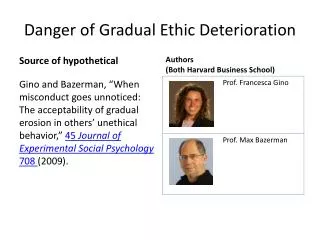
Danger of Gradual Ethic Deterioration Source of hypothetical Authors (Both Harvard Business School) Gino and Bazerman, “When misconduct goes unnoticed: The acceptability of gradual erosion in others’ unethical behavior,” 45 Journal of Experimental Social Psychology 708 (2009).
Hypotheticals: Auditing Financial Statements One Two Year 1: Auditor reviewed and approves accurate, ethical statement Year 2: Company position aggressive but doesn’t violate law. Auditor approves. Year 3: Company position even more aggressive but still not illegal. Auditor approves. Year 4: Company stretched legal limits, possibly breaking some. Expected auditor response? • Year 1: Auditor reviews and approves accurate, ethical statement. • Year 2: Same as previous year. • Year 3: Same as previous year. • Year 4: Company stretched legal limits, possibly breaking some. Expected auditor response?