Pedigrees
Pedigrees. What is a Pedigree?. A pedigree is a diagram of family relationships that uses symbols to represent people and lines to represent genetic relationships. These diagrams make it easier to visualize relationships within families, especially large extended families.


Pedigrees
E N D
Presentation Transcript
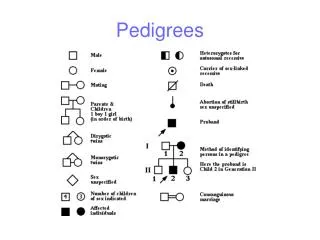
What is a Pedigree? • A pedigree is a diagram of family relationships that uses symbols to represent people and lines to represent genetic relationships. These diagrams make it easier to visualize relationships within families, especially large extended families. • Pedigrees are often used to determine the mode of inheritance (dominant, recessive) of genetic diseases. • Squares represent males. • Circles represent females. • Horizontal lines linking a • male and female represent • mating. Vertical lines • extending downward from • a couple represent their children.
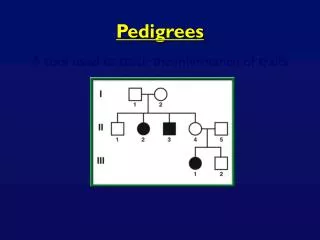
If the purpose of a pedigree is to analyze the pattern of inheritance of a particular trait, it is usual to shade in this trait. • Infected male In this pedigree: the grandparents had three children, two boys and one girl. The daughter married and Produced two grandchildren, both boys. The grandfather has the trait. The daughter is a carrier. One of the grandsons has the trait.
Types of Inheritance • There are four types of inheritance patterns that we will be analyzing: • 1. autosomal dominant • 2. autosomal recessive • 3. X – linked dominant • 4. X- linked recessive
Autosomal Dominant • A – has the trait • a – normal (no trait, recessive) • Autosomal Recessive • A – normal ( no trait, recessive) • a – has the trait
X – Linked Dominant • XA – has the trait • Xa– normal • Y – Y chromosome (males only) • X – Linked Recessive • XA– normal • Xa – has the trait • Y – Y chromosome (males only)
Locus • The location of a gene. • For example, the locus of the gene OCA1 (or Oculocutaneous Albanism Type 1, the gene associated with albinism) is on 11q1.4-2.1, which means it is on the long arm of chromosome 11, between sub-band 4 of band 1 to sub-band 1 of band 2.