Genetics
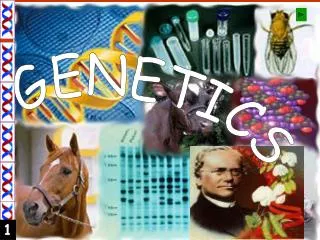
Genetics. Unit 8. Gregor Mendel – The Father of Genetics. Lived from 1822-1884 Austrian monk Studied pea plants Developed the Laws of Inheritance The importance of his work was not recognized until the 20 th century. Site of Gregor Mendel’s Experimental Garden.

Genetics
E N D
Presentation Transcript
Genetics Unit 8
Gregor Mendel – The Father of Genetics • Lived from 1822-1884 • Austrian monk • Studied pea plants • Developed the Laws of Inheritance • The importance of his work was not recognized until the 20th century
Particulate Inheritance • Mendel knew that something was passed from parent to offspring that affected physical traits he called them “particles” • He did not know that these particles were actually chromosomes and DNA
Words to Know… • Trait- any characteristic that can be passed from parent to offspring • Heredity- passing of traits from parent to offspring • Genetics- study of heredity • Gene- a sequence of DNA that codes for a protein and thus determines a trait
Punnett Squares • Created by Reginald Punnett (1875-1967) • Used to help solve genetics problems
Punnett Square Rules: • One parent per side of the square • Capital letters always come first: Aa = correct, aA = wrong • Keep the same letters together:AaBB = correct, ABBa = wrong
Types of Crosses • Monohybrid cross - cross involving a single traitExample: seed color • Dihybrid cross - cross involving two traits Example: seed color AND wrinkled/smooth
Words to Know… • Alleles- two forms of a gene(dominant & recessive) • Dominant - stronger of two genes expressed in the hybrid; represented by a capital letter (R) • Recessive – gene that shows up less often in a cross; represented by a lowercase letter (r)
Words to Know… • Genotype - gene combination for a trait(e.g. PP, Pp, pp) • Phenotype - the physical feature resulting from a genotype(e.g. purple, white)
Words to Know… • Homozygousgenotype - gene combination involving 2 dominant or 2 recessive genes (ex. RR or rr);also calledpure-bred • Heterozygousgenotype - gene combination of one dominant & one recessive allele (ex. Rr);also calledhybrid
Mendel’s Experiments • Why use peas? • They can be grown in a small area • They produce many offspring very quickly • They can be self-pollinated to make pure-breds • They can be artificially cross-pollinated to make hybrids
Mendel’s Experiments • Mendel studied the peas over several generations • He observed and recorded 8 traits: • Seed shape--- Round (R) or Wrinkled (r) • Seed Color---- Yellow (Y) or Green (y) • Pod Shape--- Smooth (S) or wrinkled (s) • Pod Color--- Green (G) or Yellow (g) • Seed Coat Color---Gray (G) or White (g) • Flower position---Axial (A) or Terminal (a) • Plant Height--- Tall (T) or Short (t) • Flower color --- Purple (P) or white (p)
Words to Know… • Parental P1 Generation= the parental generation in a breeding experiment. • F1 generation= the first-generation offspring in a breeding experiment. (1st filial generation) • From breeding individuals from the P1 generation • F2 generation= the second-generation offspring in a breeding experiment. (2nd filial generation) • From breeding individuals from the F1 generation
Following the Generations Cross 2 Pure PlantsTT x tt Results in all HybridsTt Cross 2 Hybridsget3 Tall & 1 ShortTT, Tt, tt
P1 Monohybrid Cross • Trait: Seed Shape • Alleles: R – Round r – Wrinkled • Cross: RoundseedsxWrinkled seeds RRxrr Genotype:Rr Phenotype:Round GenotypicRatio:All alike PhenotypicRatio: All alike r r Rr Rr R R Rr Rr
F1 Monohybrid Cross • Trait: Seed Shape • Alleles: R – Round r – Wrinkled • Cross: Roundseeds xRound seeds RrxRr Genotype:RR, Rr, rr Phenotype:Round & wrinkled G.Ratio:1:2:1 (25%, 50%, 25%) P.Ratio:3:1 (75%, 25%) R r RR Rr R r Rr rr
…And Now the Test Cross • Mendel then crossed a pure & a hybrid from his F2 generation • This is known as an F2 or test cross • There are two possible testcrosses:Homozygous dominant x HybridHomozygous recessive x Hybrid
F2 Monohybrid Cross (1st) • Trait: Seed Shape • Alleles: R – Round r – Wrinkled • Cross: RoundseedsxRound seeds RRxRr Genotype:RR, Rr Phenotype:Round GenotypicRatio:1:1 PhenotypicRatio: All alike R r RR Rr R R RR Rr
F2 Monohybrid Cross (2nd) • Trait: Seed Shape • Alleles: R – Round r – Wrinkled • Cross: WrinkledseedsxRound seeds rrxRr R r Genotype:Rr, rr Phenotype:Round & Wrinkled G. Ratio:1:1 P.Ratio: 1:1 Rr rr r r Rr rr
bC b__?_ bc Test Cross • A mating between an individual of unknown genotype and a homozygous recessive individual. • Example:bbC_?_ x bbcc • BB = brown eyes • Bb = brown eyes • bb = blue eyes • CC = curly hair • Cc = curly hair • cc = straight hair
bC b___ C bC b___ c bc bbCc bbCc or bc bbCc bbcc Test Cross • Possible results:
Law of Dominance • Dominant traits mask recessive traits • In a cross of parents that are pure for contrasting traits, only one form of the trait will appear in the next generation. • All the offspring will be heterozygous and express only the dominant trait. • RR x rryields all Rr (round seeds)
Law of Segregation • Only one allele is passed on from each parent • During the formation ofgametes (eggs or sperm), thetwoalleles responsible for a trait separate from each other. • Alleles for a trait are then "recombined" atfertilization, producing the genotype for the traits of the offspring.
Law of Independent Assortment • Alleles for different traits are inherited independently from one another • Example: You can get your hair color from Mom and your eye color from Dad
How many types of gametes can be produced? • Formula = 2n • n = # of heterozygous alleles • 1. RrYy n=2 4 different gamete types • 2. AaBbCCDd n=3 8 different gamete types • 3. MmNnOoPPQQRrssTtQq n=6 64 different gamete types
Incomplete Dominance • F1 hybrid offspring will have a “blended” appearance between the two phenotypes • Example: Snapdragons (flower) • Red (RR) x white (rr) = Pink (Rr)
Codominance • Two different alleles are completely expressed at once in heterozygous individuals • Example: Calico cat expresses orange AND black genes • Example 2: Human blood type Four types: • 1. type A = IAIA or IAi • 2. type B = IBIB or IBi • 3. type AB = IAIB • 4. type O = ii
Codominance • Question:If a boy has a blood type O and his sister has blood type AB, what are the genotypes and phenotypes of their parents? • boy-type O (ii) X girl-type AB (IAIB)
IA i IAIB IB i ii Codominance • Answer: Parents: genotypes = IAi and IBi phenotypes = A and B
What does this symbol mean? • RR’ • It is just another way of marking a trait • For example: Instead of R = red and r = white, you have R = red and R’ = white • It is usually used with non-Mendelian genetics What is this?
Sex-linked Traits • Traits (genes) located on the sex chromosomes • Sex chromosomes are X and Y • XX genotype for females • XY genotype for males • Many sex-linked traits carried on X chromosome • Therefore, males are the most affected no “back-up copy”
fruit fly eye color XX chromosome - female Xy chromosome - male Sex-linked Traits Example: Eye color in fruit flies Sex Chromosomes
Xr Xr XR Y Sex-linked Trait Problem • Example: Eye color in fruit flies • (red-eyed male) x (white-eyed female)XRY x XrXr • Remember: the Y chromosome in males does not carry traits. • RR = red eyed • Rr = red eyed • rr = white eyed • XY = male • XX = female
Xr Xr XR Xr XR Xr XR Y Xr Y Xr Y Sex-linked Trait Solution: 50% red eyedfemale 50% white eyed male
What is a carrier? • A carrier is an individual who has a recessive trait that they can pass on to their off-spring, but don’t express • They “carry” it to the next generation • For sex-linked traits, women are usually carriers
How do we study human genetics? • There are some major problems scientists must overcome to study human genetics • It is not ethical to do a test cross on a human being • Humans have long life spans, long gestational period, and a small number of offspring hard to trace a trait over several generations
How do we study human genetics? • Population sampling = study how often a trait is found in a small, randomly selected group • Problem: It is really hard to get a truly random sample • Pedigree = a graphic record of a trait over several generations within a family; use family/historical records, photographs, medical records, etc. • Only trace ONE trait per pedigree
Connecting lines indicate relationships in a family • P1 • F1 • F2
Pedigree Example • The parents in the P1 generation MUST have been carriers • Neither of them show the trait, but they had a child who did • Therefore, they CARRIED the trait to the next generation
Genetic Disorder vs Chromosomal Disorder • A genetic disorder is caused by a defect in a single gene • A chromosomal disorder is caused by an entire extra or deleted chromosome