Geographic and Historical Influences Shaping Japan's Unique Development
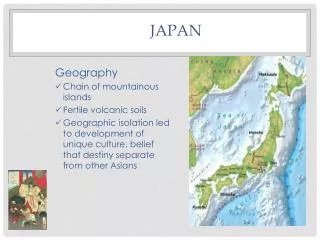
Japan's geographic features, including its island status and mountainous terrain, contributed to fewer invasions and a decentralized government. The historical unification under the Yamato clan and the influence of Chinese culture, particularly during the 7th to 9th centuries, further shaped its society and governance. This period saw the introduction of Buddhism, Confucian ideas, and centralized bureaucratic systems. Despite these influences, Japan maintained its distinct identity through feudalism, the samurai class, and unique cultural practices, resulting in a rich historical tapestry.

Geographic and Historical Influences Shaping Japan's Unique Development
E N D
Presentation Transcript
Geographic Factors • Islands off coast?
Geographic Factors • Islands off coast • Fewer invasionsless need for central gov’t • Pick and choose for. infl
Geographic Factors • Islands off coast • Fewer invasionsless need for central gov’t • Pick and choose for. Infl • Mountainous?
Geographic Factors • Islands off coast • Fewer invasionsless need for central gov’t • Pick and choose for. Infl • Mountainous • Polit Fragmentation • Collective Rights
Geographic Factors • Islands off coast • Fewer invasionsless need for central gov’t • Pick and choose for. Infl • Mountainous • Polit Fragmentation • Collective Rights • Poor natural resourcesTraders and manufacturers
Centralization under Yamato • Uji • Yamato clan unifies Japan • Shinto • Head of Yamato ClanReligious Leader • Same dynasty throughout Japanese History • Religious vs. Polit Authority
Chinese Influence • Japanese Borrowing peaks in 7th-9th • Examples of Chinese Influence • Buddhism • Confucian ideas gov’t/education • Chinese written script • Prince Shotoku (572-622) • Missions to China • Court ritual • Taxation, law codes • Centralized Bureaucracy
Shotoku’s Seventeen-Article Constitution • Why do we need central authority? • Evidence of Confucian Influence? • Legalist Influence? • Buddhist Influence? • Mandate of Heaven?
Taika Reforms (7th) • Continues Chinese style governance • Limits to Effects • Buddhist Resistance • Aristocratic Resistance • Results
Samurai and Bushi • Feudal Mini-Kingdoms • Bushi • Samurai • Bushido • Ritualized Fighting • Ideal Behaviors
Disintegration and Daimyo • Decline of Hojo • Mongols • Rise of MC hurts Samuraibanditry • Ashikaga Shogunate (1336-1573) • Challenges • Destructive Civil War • Daimyo
Decline of Samurai • Decline of Bushido • Changes in Warfare • Economic Growth • Continued Decline in Tokugawa
Japanese Particularity • End of Chinese Borrowings • Samurai/Bushido code • Religion • Women
The Chronicle • Context: KitabaakeChikafus • What makes Japan special? • Compare to China? • Compare to India? • Buddhism and Confucianism?