Download
1 / 12
130 likes | 234 Vues
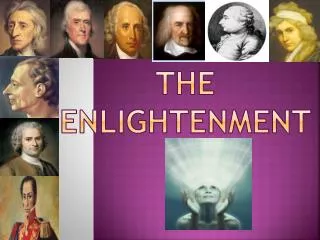
The Enlightenment, which began in Paris, profoundly influenced political thought across Europe and the Americas. Central to this intellectual movement were philosophers like Thomas Hobbes, John Locke, and Jean-Jacques Rousseau, whose ideas on governance, individual rights, and social contracts inspired democratic revolutions. Other key figures included Montesquieu, who advocated checks and balances, and Simon Bolivar, who pushed for independence in Latin America. This period laid the groundwork for modern democratic principles, emphasizing reason, equality, and the importance of the people's voice in government.

E N D
Who, what, AND WHERE? • Started in Paris, spread throughout Europe and American • Political thinkers at the heart of the movement. • Their ideas inspired democratic revolutions in Europe, U.S., and Latin America. • Reason people challenge the old ways of government absolutism Louis XVI
Thomas Hobbes • English Philosopher • Wrote the Leviathan • Beliefs: • 1. people are naturally wicked gov. is necessary • 2. Gov.’s job is to protect people from themselves • 3. People joined into a social contract and submit to an authoritarian ruler to prevent disorder. • In the contract, citizens accept responsibilities and rights, and grant the gov. the power to uphold them • Other philosophers will later pickup this theory (Locke & Rousseau)
John Locke • English Philosopher • Beliefs: • 1. All men can reason • 2. Ppl. have natural rights to life, liberty, and ownership of property. • 3. Ppl. form govs. to protect those natural rights. • 4. If the gov. does not protect the natural rights, ppl. can form a new gov. • 5. Gov. gets it authority from the ppl. so it should do what the ppl. want. • His ideas used in the Declaration of Independence by Thomas Jefferson !
Charles-Louis Montesquieu • French Philosopher • Beliefs: • 1. Any person or group will try to increase their power • 2. Gov. kept under control through separation of powers. • 3. Governmental balance achieved with three branches of gov. checks and balances • Ideas used in the Constitution by James Madison
Jean-Jacques Rousseau • French Philosopher • Beliefs: • 1. Advocated direct democracy he advanced democracy • 2. A social contract exists between citizens and the gov. • Unlike Hobbes, he believed people could live peacefully in a state of nature • 3. Gov. should respond to the people’s will—consent of the governed
Simon Bolivar • Venezuelan & Latin-American Revolutionary Leader • Influenced by Locke’s natural rights and Rousseau’s idea on the social contract theory. • Sought independence from Spain and the creation of a democracy • Supported the free market economic system: capitalism
Thomas Jefferson • Beliefs: Influenced by Locke • 1. Rights received at birth (unalienable rights) • 2.Government in power because the ppl. put it theregov. must do what the ppl. want. • Main author of the Declaration of Independence. • His statement, “Life, liberty, and the pursuit of happiness” is similar to Locke’s idea.
James Madison • Know as the “Father of the Constitution” • Created the Federal system • Gov. power divided between a centralgov. and local gov. • Came up with the idea for the Great Compromise bicameral Congress
Mary Wollstonecraft • Beliefs: • 1. All people are equal-including women • 2. Women need more economic, political, and social rights • Founder of the European and American movement for women’s rights • 3. Society will benefit if women are educated and allowed to participate in gov.
Niccolo Machiavelli • Wrote The Prince • Describes how a ruler can gain political power and keep it. • Belief: • 1. You could be a good ruler even if you weren’t moral. • Effectiveness instead of morality
Voltaire • Is freedom of speech important? EXPLAIN your answer ___________________________________________________________________ ______________________________________________________________________ 2. Should freedom of speech ever be limited? EXPLAIN your answer ______________________________________________________________________ ______________________________________________________________________ Advocated freedom of speech Advocated freedom of religion & religious tolerance Beccaria Cruel and unusual punishments don’t stop crimes Punishment must fit the crime • Should capital punishment (the death penalty) be used as a form of punishment? EXPLAIN your answer. ________________________________________________________________ ________________________________________________________________