Understanding Lateral Surface Area of a Cylinder: Practice and Solutions
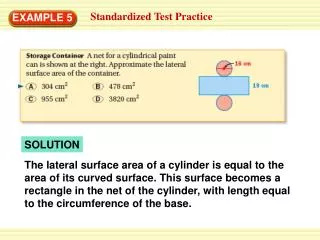
This guide explores the computation of the lateral surface area of a cylinder, demonstrating that it equates to the area of its curved surface. Using the formula ( A = 2pi rh ), you'll see how to calculate the area by substituting the radius and height. For example, with a radius of 8 cm and height of 19 cm, the lateral surface area is approximately 955 cm². Additionally, a practice question examines a cylinder with a radius of 5 inches and height of 10 inches, encouraging you to approximate its lateral surface area.

Understanding Lateral Surface Area of a Cylinder: Practice and Solutions
E N D
Presentation Transcript
Standardized Test Practice EXAMPLE 5 SOLUTION The lateral surface area of a cylinder is equal to the area of its curved surface. This surface becomes a rectangle in the net of the cylinder, with length equal to the circumference of the base.
ANSWER The lateral surface area of the container is about 955 cm2. The correct answer is C. Standardized Test Practice EXAMPLE 5 =2πrh Lateral surface area Multiply circumference and height. = 2π(8)(19) Substitute 8 for rand 19 for h. ≈ 955.04 Evaluate using a calculator.
ANSWER The lateral surface area of the container is about 314 in.2 for Example 5 GUIDED PRACTICE 4. What If? Suppose the radius of the cylinder in Example 5 is 5 inches and the height is 10 inches. Approximate the lateral surface area.