Charting Our Future: A Vision for Excellence in Coffee County Public Education
The Coffee County School System presents its strategic vision, "Charting Our Future," to enhance public education in Georgia. This comprehensive plan includes our commitment to full AdvancEd SACS Accreditation, achieving Charter System status, and developing a strategic plan that prioritizes student success. Our guiding principles emphasize readiness, effective teaching, and community engagement, ensuring that all children have equal opportunities to learn and succeed. By involving parents, educators, and the community, we strive for a supportive and effective learning environment.

Charting Our Future: A Vision for Excellence in Coffee County Public Education
E N D
Presentation Transcript
Coffee County School System Sept 2012
Priorities • Full AdvancEd SACS Accreditation • Charter System Status • Strategic Plan for Coffee County School System
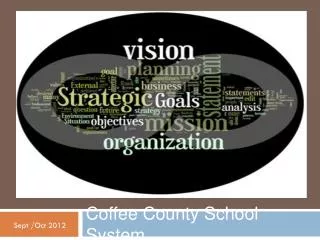
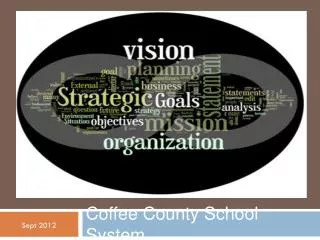
Pulling it all together… Beliefs Guiding Principles Mission Vision Goals Objectives
Beliefs • All children can learn • The family plays the most important role in a young child’s life • Children come to school at different levels of readiness • People learn in diverse ways and at different rates • Students’ needs must drive educational decisions • The schools are responsible for educating all children • A relationship exists between expectations and learning • A quality education prepares students for college, career, and life • Learning occurs when students are motivated and engaged
Beliefs • Effective teaching promotes learning • Nurturing relationships support learning • Creating a caring culture is key to engaging all learners • Community engagement and support are vital for effective schools • Parents, schools, community, and students share the responsibility for each student’s educational success • The community and the state have a legal, moral, and ethical responsibility to ensure that a viable public educational program is provided for all children and youth • Visionary leadership is essential to continuous improvement • Employing and retaining highly qualified, effective staff and providing opportunities for their professional growth are crucial to the schools’ effectiveness
Guiding Principles School Readiness • Responsibility for children’s readiness lies with the adults who care for them and the systems that support them • The first five years of life are a critical developmental period
Guiding Principles Teaching and Learning • High levels of learning are attainable for all students • A viable curriculum is comprehensive in scope, balanced, continually improved, connected to the real world, and based on a common set of learning expectations • Instructional strategies have a significant influence on student learning • Balanced assessments are an integral component of effective teaching • Integration of technology enhances student engagement • Learning is a function of accessibility to information and the ability to make judgments about the quality of the information • Learning is enhanced when the learning environment is flexible and adaptable • People need a combination of real and virtual places for learning
Guiding Principles Human Resources • Selection and ongoing support of teachers and leaders affect the quality of teaching • Adequate compensation and ongoing performance evaluation and feedback are essential to retaining high-quality teachers and leaders • Motivation and attitude are major determinants of performance • Professional collaboration enhances effectiveness at all levels
Guiding Principles Governance and Leadership • Effective governance requires a strategic vision • Good governance requires effective leaders with integrity, ethical behavior, and good intent • Organizational structures and processes at the school and system levels affect learning • Highly reliable schools and school systems are consistent in holding high expectations for everyone • Effective leadership is crucial to creating a climate and culture that are conducive to learning
Mission Destination Graduation for College, Career, and Life
Vision An equitable and excellent education for every student
Goals Goal 1: Children entering school ready to learn Goal 2: A curriculum that is broad, challenging, relevant, and real for all students Goal 3: Instructional practices that increase student motivation, engagement, and success Goal 4: A balanced student assessment system with multiple measures of student learning Goal 5: High school graduates who are ready for college or career entry and for life itself Goal 6: Organizational and governance structures that support student learning Goal 7: A highly reliable and accountable school system that guarantees qualified and effective leaders, teachers, and support staff throughout the school system Goal 8: Increased parental engagement and satisfaction and improved community relations Goal 9: Adequate financial resources expended effectively and efficiently to maximize student learning
More to come… Goals Objectives Strategies